


This article is part of a series by PeerSpectives Consulting. Check out Part 1: People don’t want a boss. People want a coach, and Part 2: Using a coach approach for performance development.
In this series of articles, beginning with the first article called People don’t want a boss. People want a Coach, and the second article, Using a Coach Approach for Performance Development, I have outlined the Gallup research behind the movement of people wanting to have a manager who coaches them to develop and grow.
The series of articles has focused on managers, at all levels, and how they can take a Coach Approach. However, let’s take the perspective of being the employee who is on the receiving end of coaching.
Gallup Research suggests that only 16% of employees report that someone took an interest in developing their Strengths in the last week. Yet managers can support their team members in growing and developing by creating frequent dialogues about Strengths and performance. [i]
The research also indicates that employees should be having these types of conversations with their managers weekly. [ii]
Employees want to grow in their roles
Imagine if you had a manager who provided an environment that fostered your development and also supported you, so you could do your best work. A person who could identify possible growth opportunities for you that are tied to your Strengths, setting you up for success.
How would that impact you?
When we are able to lean into our Strengths with stretch assignments, we develop new skills, we are engaged, and we are energized! And when managers speak with direct, honest communication, it has the potential to encourage people to do their best work.
When managers have the intention to foster development, they will likely be looking to provide stretch assignments or growth requests. A growth request is asking someone to step outside of their comfort zone and take on a project or assignment, so they can grow and develop.
There are a few steps a manager could take in a coaching conversation with an employee or team member. However, it requires that the manager is on the lookout to spot the Strengths exhibited and to spot the potential that could be developed.
The first step is for the manager to share what they have noticed about the coachee. For example, the manager could say. “I noticed you have a gift for making great presentations”.
Next, the manager can state that they have a growth request, leveraging the potential they’ve identified. For instance, “I have a request. Would you be open to presenting your recent findings to the senior team tomorrow?”
Here is another example:
3 Steps:
- Identify and share the potential you’ve seen in action
- State ‘I have a request’
- Make the request
Example:
- I admire your willingness to try new things.
- I have a request.
- Will you represent us at an upcoming conference?
However, to ensure that the team member feels supported, the manager can look to the coachee’s Strengths, as identified in assessments such as the Gallup Top 5 Strengths report. This information allows the pair to discuss which Strengths the coachee could bring or “lean into” to accomplish the task assigned.
The Gallup Bring/Need Report
One tool to facilitate this part of the conversation is the Gallup “Bring/Need” report.
At PeerSpectives Consulting, when we are working with our clients, we provide each team member with their “Bring/Need” report. See a sample here.
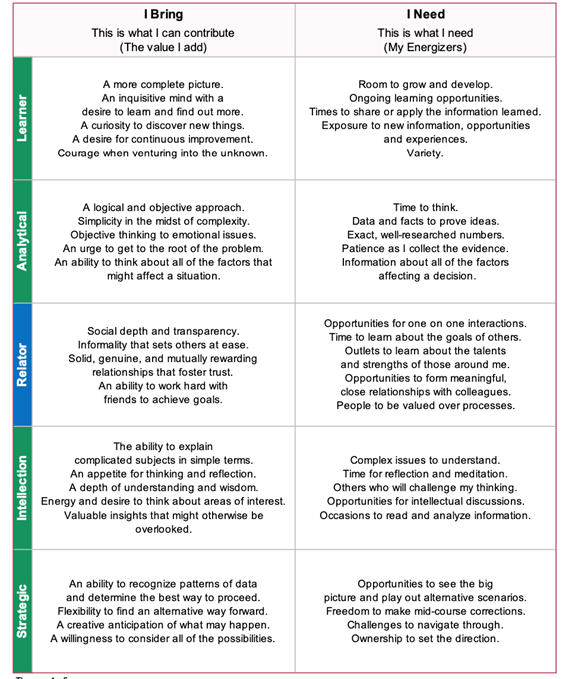
The individual’s Top 5 Strengths are listed down the left-hand side. For each Strength, there are concise sentences that outline what each Strength “brings “and what each Strength “needs”.
In the “I Bring “ column, individuals can see a summary of how each Strength contributes to their role or a situation.
Managers can discuss with the team member how each Strength could aid them in accomplishing the growth request.
In addition, the one-page “Bring/Need” report identifies what the individual “needs” to be successful. This is key information for both the coachee and the manager to review, and provides the manager with ideas on how to support the coachee.
When you are given opportunities to use your Strengths in a stretch assignment, you will be energized as you see your Strengths enhance the situation and add value.
This approach to fostering development is part of Session #3, in our Coach Approach Program using the Coach Approach Model.
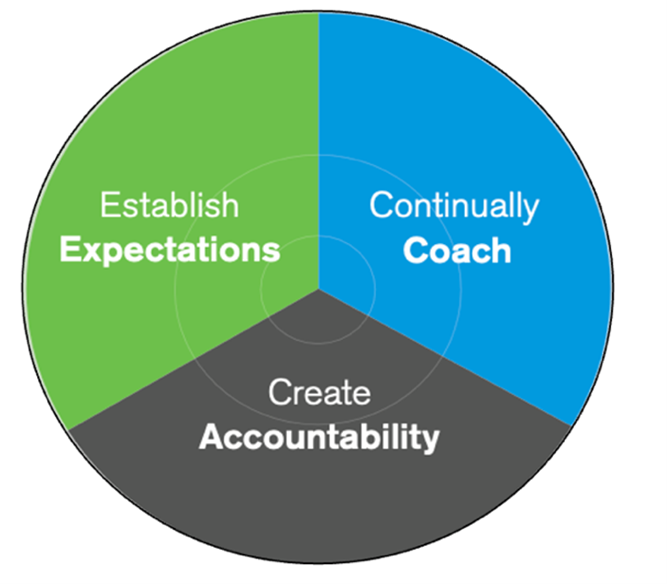
Source: Ben Wigert, PH.D, and Jim Harter, PH.D, Re-engineering Performance Management, page 15
Want to learn more? Access training for managers at all levels
At PeerSpectives Consulting, we have developed a virtual program to build coaching skills for managers of all levels. Louann McCurdy, my co-founder of PeerSpectives and a coach with International Coach Federation credentials, has a deep background in using coaching best practices.
As we are both Gallup-Certified Strengths Coaches, we built our Strengths-Based Coach Approach program based on three “coach approach” principles.[1] Establishing Expectations, Continually Coaching, and Creating Accountability. At each session, participants are introduced to coaching skills.
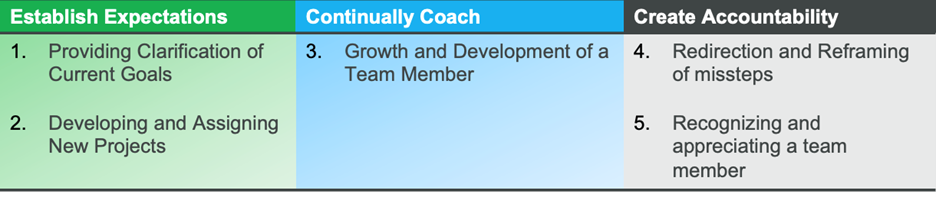
The coaching skills introduced to participants in Session #3 are “Speaking with Direct and Honest Communication”. The Coaching Conversation topic that participants will practice the deep listening techniques with is “Growth and Development of a Team Member”, which is part of the Continually Coach section of the model.
Our virtual program runs over 5 sessions and introduces participants to coaching skills and 5 key Coaching Conversations. Each session allows time to practice the skills and is centered around one of the conversation topics. The practice sessions are completed in triads, with each person taking a turn at being the Coach, the Coachee, and the Observer.
The 4 Coaching Skills introduced are:
- Asking closed-ended and open-ended questions
- Applying deep listening techniques and reflecting back
- Speaking with direct, honest communication
- Empowering others to find their internal sources of power
The 5 Coaching Conversation Topics introduced are:
- Providing clarification of current goals
- Developing and assigning new projects
- Growth and development of a team member
- Redirection and reframing of missteps
- Recognizing and appreciating team members
As people change and wish for more of a Coach than a Boss, it’s important for managers at all levels and leaders to feel confident that they can learn and hone these coaching skills, setting them and their employees up for success!
Stephanie Koonar, Co-Founder of PeerSpectives Consulting, a team building and personal development company. An award-winning instructor with over 20 years of teaching and administration experience in Higher Education, she has taught over 4,000 learners. As a Gallup-Certified Strengths Coach, she empowers people to unlock their potential to be their best. MBA, BA Psychology. Gallup-Certified Strengths Coach. www.peerspectives.ca
SK.peerspectives@gmail.com
Louann McCurdy, Co-Founder of PeerSpectives Consulting, helps people bring forth the best of themselves. As an Engineer, I/T professional, Project Leader, and Career Coach, living and working in 5 countries (Canada, USA, Singapore, France, India), she has worked with diverse groups of people, and has seen how understanding Strengths leads to career success. An International Coach Federation credentialed coach.
B.Sc. Engineering, B.Ed. Adult Ed Gallup-Certified Strengths Coach. www.peerspectives.ca
[1] Ben Wigert, PH.D, and Jim Harter, PH.D, Re-engineering Performance Management, page 15
[i] Re-Engineering Performance Management, Ben Wigert, PH.D, and Jim Harter, PH.D, page 37
[ii] Re-Engineering Performance Management, Ben Wigert, PH.D and Jim Harter, PH.D, page 60
The views expressed in this article are the author’s alone and do not necessarily represent those of CharityVillage.com or any other individual or entity with whom the authors or website may be affiliated. CharityVillage.com is not liable for any content that may be considered offensive, inappropriate, defamatory, or inaccurate or in breach of third-party rights of privacy, copyright, or trademark.
