

Interested in learning more? We have partnered with SDP to host a product demo. Watch the recording!
The importance of a healthy daily routine
At SDP, we are proud to serve nonprofit organizations that provide essential services to the community. The specific challenges faced by individuals who use resources that employ an ASO system are diverse, but one common issue is the difficulty of maintaining activities of daily living (ADL). Regardless of the difficulty experienced, one area where change can be quickly observed is in activities of daily living. Liang et al. (2022) observe a direct correlation between the degree of disruption to daily activities and the severity of anxiety and depressive symptoms.
Some resources offer assistance directly related to ADLs by providing services such as food assistance, cooking workshops, socialization opportunities, activities, etc. Others almost automatically integrate activities of daily living into the intervention plan for their diverse populations. Several of the organizations that use an ASO system offer accommodation services where the person is housed within the resource and often participates in daily tasks, among other things, to promote a return to a healthy level of daily living activities. Regardless of the form of assistance offered, many of the elements discussed may apply.
Integrating ADLs into the intervention plan
Brown (2022) highlights how providing support in establishing a daily routine is a simple and accessible intervention that is effective in reducing psychological symptoms.
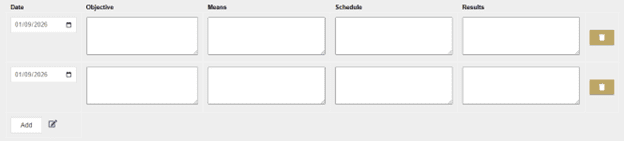
In ASO systems, one tool that is often used is the intervention plan. The intervention plan allows specific goals to be set and monitored:
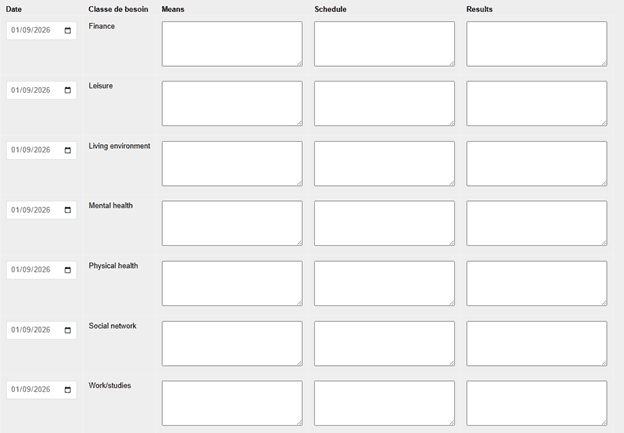
It is also possible to have predefined objectives that appear as soon as a new intervention plan is created. By choosing predefined objectives related to ADLs, it would therefore be possible to highlight the importance of paying attention to this area:
Group activities as a lever for action
Heubner & Tryssenaar (1996) highlight the benefits of organizing activities for people staying in homeless shelters. They observed that organizing fun activities accessible to all residents improved communication and social functioning among participants. It was another way to get people back on their feet.
Salles & Barros (2009) indicate that daily living activities and social participation decline as a result of mental health issues. They also report that mental health services therefore greatly value these activities as they promote independence and a place in society.
For group activities, the ASO system can be used for both group interventions and activities. These two sections allow you to organize and track group activities: recreational activities, resident meetings, etc. Participation tracking is also managed by these sections. Some resources also use these sections to manage registrations and waiting lists directly on the activity page.
The unique characteristics of a residential resource
Schultz-Krohn (2004) highlights the importance of family routines regardless of context by sharing the results of his research on parents living in a homeless shelter. The parents who participated in the study made significant efforts to establish and maintain family routines in order to foster closeness and a sense of community. He encourages resources working in this area to support parents in their role as organizers of family routines. Koome et al. (2012) found that routines promote activation and become the foundation on which families with adolescents facing mental health challenges can organize their lives, fulfill obligations, and support each other.
McNulty et al. (2009) studied how twenty-three women living in a shelter for women who are victims of domestic violence spent their time. The study highlighted the particularities of living in such a resource: shared living space with several other women and children, which also requires joint organization of household tasks; a strict framework to ensure everyone’s safety, which limits opportunities for socialization with the usual network; and a significant investment of time and energy in administrative procedures. The researchers suggest that workers in women’s shelters support women in establishing good routines to promote long-term goals.
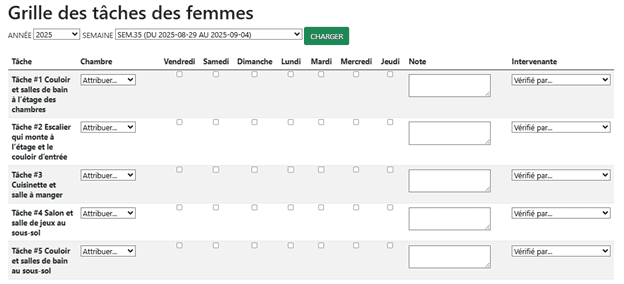
We will share the example of a women’s shelter that uses a specific module in ASO to manage residents’ tasks. This module allows a specific task to be assigned to the resident/family residing in an identified room. A list of tasks is generated for each week. Adjustments could be made to allow a task to be assigned to more than one room in order to create opportunities for interaction and teamwork between the people sharing a task.
Register now for the Introduction to ASO – Organization Management Software Product Demo.
James Zhang studied psychology and spent many years leading digital services at Suicide Action Montréal. He now directs ASO software development at SDP Inc. SDP Inc. builds human‑centred software for the psychosocial sector and uses our nonprofit volunteer experience to create solutions that serve clients and communities.
Sources
Brown, K. (2022). The rhythm of your life: The effects of daily routine on mental health (Literature review). Southern Adventist University. https://knowledge.e.southern.edu/gradnursing/98/
Heubner J, Tryssenaar J. Development of an Occupational Therapy Practice Perspective in a Homeless Shelter: A Fieldwork Experience. Canadian Journal of Occupational Therapy. 1996;63(1):24-32. doi:10.1177/000841749606300104
Koome, F., Hocking, C., & Sutton, D. (2012). Why routines matter: The nature and meaning of family routines in the context of adolescent mental illness. Journal of Occupational Science, 19(4), 312–325. https://doi.org/10.1080/14427591.2012.718245研飞ivySCI+3
Liang, L., Hou, W. K., Li, T. W., Liu, H., Goodwin, R., & Lee, T. M. C. (2023). Latent Profiles and Transitions of Daily Routine Disruptions Are Associated with Severity of Symptoms of Anxiety and Depression. Leisure Sciences, 1–16. https://doi.org/10.1080/01490400.2023.2228311
McNulty MC, Crowe TK, Kroening C, VanLeit B, Good R. Time Use of Women with Children Living in an Emergency Homeless Shelter for Survivors of Domestic Violence. OTJR. 2009;29(4):183-190. doi:10.3928/15394492-20090914-06
Moraes Salles, M. & Barros, S. (2009). Atenção domiciliar: uma prática em construção. Texto & Contexto – Enfermagem, 18(1), 1–2. https://doi.org/10.1590/S0103-21002009000100002
Schultz-Krohn, W. (2004). The meaning of family routines in a homeless shelter. American Journal of Occupational Therapy, 58(5), 531–542. https://doi.org/10.5014/ajot.58.5.531
The views expressed in this article are the author’s alone and do not necessarily represent those of CharityVillage.com or any other individual or entity with whom the authors or website may be affiliated. CharityVillage.com is not liable for any content that may be considered offensive, inappropriate, defamatory, or inaccurate or in breach of third-party rights of privacy, copyright, or trademark.
