

This article explores entrepreneurial nonprofit board governance as a practical new approach to board leadership, and how boards can use their meeting time more intentionally across fiduciary, strategic, and generative leadership, so governance becomes a source of direction, not just oversight.
Nonprofit boards today are operating in conditions that are more complex, more uncertain, and more constrained than the governance models most of them were trained in.
Demand for services continues to rise. Funding is more competitive and more restricted. Costs are increasing. Staff turnover is real. Expectations from funders, regulators, and communities are growing. At the same time, boards are expected to provide direction, oversight, and leadership with one of their most limited resources: time.
Most nonprofit boards meet for about 15 hours a year.
That reality raises a fundamental question at the heart of effective nonprofit board governance today:
How can 15 hours of board meetings change the world?
Entrepreneurial board governance begins with this question, not as a slogan, but as a design challenge. If board time is scarce, then governance must be intentional. Not every conversation belongs at the board table. Not every issue deserves equal attention. And not every way of governing helps an organization stay focused, adaptive, and mission-aligned in a fast-changing environment.
Why most boards get stuck in oversight
Traditional nonprofit board training correctly emphasizes fiduciary duties: care, loyalty, and obedience. Boards are legally responsible for stewarding mission, resources, and integrity. That work matters. It cannot be ignored or delegated away.
But fiduciary governance is only the starting point.
In practice, many boards become stuck in the fiduciary mode. Meetings are dominated by reports, approvals, compliance monitoring, and risk avoidance. Important information is reviewed, but little time is left for shaping direction or making sense of what is changing both inside the organization and in the wider environment.
This pattern is common not because boards are disengaged, but because fiduciary work expands to fill the time available unless it is deliberately contained.
The result is familiar:
- Strategy is approved but not actively stewarded
- Risk is treated as something to avoid rather than understand
- Finance is monitored, but not clearly linked to priorities
- Boards react to issues instead of leading with intention
Entrepreneurial nonprofit board governance does not reject fiduciary responsibility. It reframes it as the floor, not the ceiling, of board leadership.
The three modes of board governance
A core framework in entrepreneurial nonprofit board governance is the recognition that boards govern in three distinct modes, each serving a different purpose (Chait et al., 2004).
- Fiduciary mode focuses on accountability, oversight, compliance, and protection of assets.
- Strategic mode focuses on direction-setting, priorities, choices, and alignment of resources.
- Generative mode focuses on sense-making: interpreting uncertainty, framing the right questions, and clarifying what is at stake.
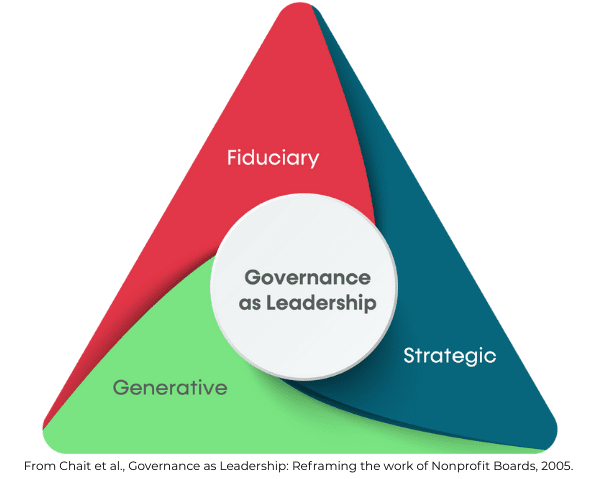
Most boards default to the fiduciary mode because it is familiar and necessary. Strategic and generative work, however, does not happen by accident. They require space, intention, and disciplined use of limited meeting time.
Entrepreneurial boards learn how to use all three modes deliberately, recognizing that different points in the year call for different kinds of conversations. Governance becomes less about reacting to what is urgent and more about focusing attention on what matters most.
Risk as uncertainty, not danger
Risk is often treated as something negative in nonprofit board governance—something to minimize or avoid. That framing can make boards overly cautious and limit their ability to act decisively.
Entrepreneurial board governance reframes risk more precisely.
Risk is uncertainty. It is the possibility that decisions, actions, or external changes may affect the organization’s ability to deliver on its mission, either positively or negatively.
Every meaningful strategic choice involves uncertainty. Avoiding risk altogether is neither possible nor desirable. Entrepreneurial boards focus instead on understanding risk well enough to respond proportionately.
They compare risks based on likelihood and impact and recognize that different responses are appropriate in different situations: retaining risk when it is aligned and manageable, reducing it where safeguards make sense, sharing it through partnerships or insurance, or avoiding it when it threatens mission or sustainability.
This approach allows boards to govern with clarity and confidence rather than fear. Risk becomes a normal part of leadership, not an obstacle to it. This opens the door to strategies where outcomes are not a given, but where the potential benefits outweigh the potential risks.
Strategy as a living decision system
In many organizations, strategy is treated as a document, developed every few years, approved by the board, and gradually disconnected from day-to-day decisions.
Entrepreneurial board governance treats strategy differently.
Strategy is a living decision system. It is how the organization makes ongoing choices about where to focus, how to allocate limited resources, and what trade-offs to accept in a changing environment.
Boards play a central role here, not by managing operations, but by staying clear about direction. Strong boards understand that strategy:
- Is forward-facing and adaptive
- Requires regular review, not occasional approval
- Links mission, priorities, and resources
- Clarifies what the organization will not do
Entrepreneurial boards also distinguish strategy from a theory of change. A theory of change explains how impact happens. Strategy determines where the organization will place its effort, given its context and capacity.
Strategic conversations are not one-time events. They are woven intentionally into the board’s work across the year. This is why the order matters. After the board revisits risk and strategy, the budget becomes the place where priorities are translated into real trade-offs and clear choices about where the organization will invest in the coming year.
Finance: where strategy becomes real
Financial oversight is a core fiduciary responsibility, but entrepreneurial board governance emphasizes something more specific: finance is where strategy becomes real.
The strategic plan and the budget are the board’s two most powerful governance tools. One sets direction. The other allocates resources. When they are aligned, money follows mission. When they are not, even strong strategies lose traction.
Entrepreneurial boards are deliberate about sequencing. Strategic priorities are clarified before the budget is approved, ensuring that financial decisions reflect intention rather than habit or constraint.
Boards also recognize that funding models matter. Revenue streams shape incentives, flexibility, and risk exposure. Thinking clearly about revenue diversification is part of strategic governance, not just financial management.
When boards understand finance this way, oversight becomes a source of confidence and stability rather than constraint.
The board and Executive Director as a leadership system
At the center of nonprofit performance is the relationship between the board and the Executive Director. Entrepreneurial nonprofit board governance treats this relationship as a leadership system, not a supervisory hierarchy.
The Executive Director is the board’s single employee and the point through which everything flows. Direction from the board flows through the Executive Director to staff and operations. Insight, context, and learning flow back through the Executive Director to the board.
This dynamic can be visualized as an hourglass: broad expectations at the top, narrow accountability in the middle, and wide organizational activity below. When that narrow point lacks clarity or support, the entire system is at risk.
Supporting and evaluating the Executive Director is one of the board’s strongest levers for impact. Effective evaluation is structured, grounded in real organizational goals, and focused on learning and alignment, not just accountability. Strong boards also reflect on their own performance, recognizing that leadership is shared.
This internal leadership system gives the organization stability at the narrow point of the hourglass. With that stability in place, board members can engage externally with confidence and consistency.
Governance beyond the boardroom
Entrepreneurial nonprofit board governance recognizes that boards do not lead only from the board table. Board members also shape how the organization is seen, trusted, and supported in the wider community.
Boards serve as a bridge between the organization and its environment—funders, partners, policymakers, media, and community members. Through their presence and relationships, board members help extend visibility, surface early signals of change, and build credibility.
This outward-facing role must be exercised with care. Board members do not freelance or speak on behalf of the board unless delegated. They do not share internal debates. They remain mindful of conflicts of interest and confidentiality.
When done well, this external engagement increases the organization’s surface area, creating more points of connection with the world around it, while remaining aligned and ethical.
Why this must work as an integrated model
Many boards attempt to improve governance by addressing individual areas, strategy, finance, evaluation, or risk. These efforts often stall because governance is not a checklist.
It is a system.
Risk, strategy, finance, leadership partnership, and community engagement reinforce one another. Entrepreneurial board governance works because it integrates these elements into a coherent way of working, designed around limited time and real-world constraints.
Turning 15 hours into leadership that matters.
Boards do not need more meetings. They need a better way of using the time they already have.
When boards govern entrepreneurially, those 15 hours a year become a source of focus, alignment, and purposeful leadership, supporting organizations to navigate uncertainty while staying anchored in mission.
That is what entrepreneurial nonprofit board governance looks like.
Learn how to apply this model in practice
Boards can put this new approach into practice through individual or team-based board governance training or facilitated workshops that apply this framework to an organization’s specific context.
Looking for an easy and affordable place to start? The Thriving Non-Profits Entrepreneurial Board Governance course introduces an entrepreneurial approach to nonprofit board governance across six modules. It walks through board leadership, risk, strategy, finance, the Executive Director relationship, and governance beyond the boardroom, and includes an annual board calendar template that sequences work across the three modes of governance throughout the year.
Get 50% off the Thriving Non-Profits Entrepreneurial Board Governance course with CharityVillage
For board members, board chairs, and executive directors ready to move beyond traditional governance, we’re pleased to partner with CharityVillage to offer an exclusive 50% discount. Build your understanding of entrepreneurial board governance and learn how to apply it in practice. Enroll now and get 50% off with code CHARITYVILLAGE.
Other ways to train your leadership team
Team enrollment: for boards and leadership teams who want a shared approach and common language for how the board will govern across the year. Contact us to customize the right learning package for your team.
Looking for a facilitated board governance workshop or deeper engagement? The Thriving Non-Profits consulting and coaching team offers guided support to help your board apply the entrepreneurial board governance framework to your organization’s context and strengthen nonprofit board leadership in practice. Contact us to discuss the right approach for your organization.
Lee Herrin, Director of Coaching and Consulting at Thriving Non-Profits. Through learning, consulting, and investment, we support non-profits and charities across Canada to expand their revenue, strengthen their teams, and grow their community impact.
The views expressed in this article are the author’s alone and do not necessarily represent those of CharityVillage.com or any other individual or entity with whom the authors or website may be affiliated. CharityVillage.com is not liable for any content that may be considered offensive, inappropriate, defamatory, or inaccurate or in breach of third-party rights of privacy, copyright, or trademark.
