


What do Oprah, Metallica, Leonardo DiCaprio, and Justin Bieber have in common? They know the value of working with a coach to unlock potential, support high-level performance, and to remain grounded and healthy – 14 Billionaires & Celebrities Get Coached.
For teams working in nonprofit organizations, coaching can have similar benefits when provided by their manager or leader. Anecdotally, our experience of working with leaders and teams in the private sector, public sector, and nonprofit organizations supports the belief that when coached by a leader or manager, employees feel valued, engaged, confident, respected, and more committed to their work, clients, and colleagues. From an organizational perspective, the benefits of coaching include improved retention, support for succession planning, and the development of a high-performance culture. This is indeed a high return for a low-to-no-cost leadership investment. Conversely, employees who do not receive coaching feel isolated, overlooked, detached, and disengaged.
The case for coaching is clear. The challenge for many leaders, who report that they would like to coach but never seem to have the time, is that, in reality, there can be a fear associated with coaching. For example, some leaders are concerned that any feedback offered or coaching provided will be viewed negatively by the employee and result in a breakdown of trust and damage the relationship. The counter-argument to this is that coaching builds trust and strengthens relationships. Another common reality is that many of us avoid conflict, so, from a manager’s point of view, it can be easier in the short-term to not have a conversation, and simply walk past a performance problem, hoping it will resolve itself. In our experience, this rarely works.
Providing feedback to team members is a key part of leadership communication – whether I’m doing it wrong, or doing it right, we both need to know. The temptation or default position for leaders who do provide feedback can be simply to say “good job” and move on. While this is of course nice to hear, it doesn’t fall into the useful feedback category aimed at improving performance. The Centre for Creative Leadership addresses this challenge with their SBI™ Feedback Model, where the leader describes the Situation (S), outlines the employee Behaviour (B), and closes the loop by explaining the Impact (I) this behaviour had on the situation. The employee is now fully aware of how their actions supported good performance, making the conversation, while still brief, much more meaningful, and useful.
While SBI™ is an effective tool, sometimes a deeper, two-way coaching conversation is required where the leader asks thoughtful questions, and, equally importantly, listens to the response from the employee to help fully understand the context, and the individual’s perspective on their performance and, crucially, the reasons behind it. By addressing the root cause of a performance issue, the employee can seek out the support needed, or take the appropriate course of action, ensuring the true barrier is being addressed. Diagnose the reason for the performance shortfall and help the employee identify the right solution. Engaging the employee in this process of assessment and intervention is critical to build individual capability.
In support of this more conversational and exploratory coaching practice, using a coaching model or framework is highly beneficial, as this helps to structure the conversation, keep the discussion on topic, and encourage the leader to focus on one issue at a time. There are many great coaching models available to leaders, and our best advice is to find one that works for you and use it consistently. During our careers as people leaders with direct reports ranging from two to twenty-nine, we used the SAGE™ Coaching Model developed by Forrest and Co in Toronto.
SAGE™ Coaching Model – reprinted with permission
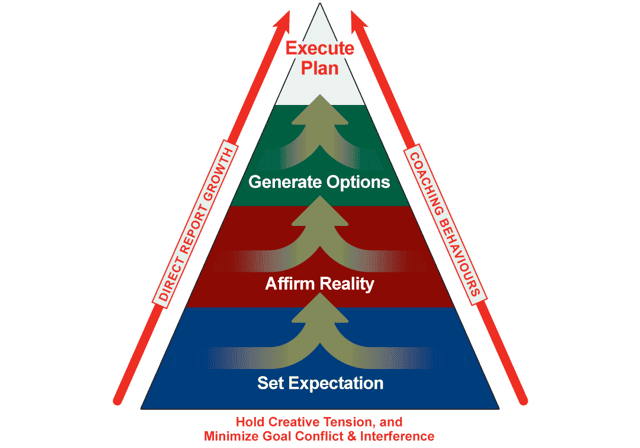
The SAGE™ coaching model supports employee growth, and is grounded in the philosophy that individuals, under the right conditions, are capable of addressing performance opportunities themselves, with varying degrees of support from their coach/manager as needed. Choose one issue at a time; no one needs to be reminded of 17 things they could do better, and engage your team member in a one-on-one conversation. In Setting Expectations (Step 1), you and the employee agree on what good performance looks like. When Affirming Reality (Step 2), you discuss the performance gap and agree on the reason for that gap. In Generating Options (Step 3), you support the employee as they identify how to course correct, and in Execute the Plan, the fourth and final step, you remain engaged by offering feedback or check-in points to the individual as they implement the agreed-to approach. Simple rules for using the SAGE™ model include not skipping any of the four steps, even if you only spend 30 seconds talking about performance Expectations because this is clear to both parties; it is always the appropriate starting point. If you feel the conversation moving off track, don’t be afraid to come back down and start again by aligning on the Expectation.
Like any tool, understanding how to use the model effectively requires some investment of time at the front end to increase your confidence; however, when a leader becomes skilled in using the SAGE™ model, a productive coaching conversation can happen when walking down the hallway – indeed, a zero-cost investment for high return.
Lake and Associates have brought the SAGE™ Coaching Model to over 1000 leaders and managers. For more information on how to incorporate the SAGE™ model into your leadership practice, please contact Rashmi Biswas at rashmi@lakeandassociates.ca.
Interested in learning how to unlock your team’s potential?
During our upcoming seminar on October 21, Leading for High Performance: Unlocking Team Potential, leaders will be encouraged to uncover their own opportunities to develop a high-performing team using a practical framework for sustained and customized application both during and after the seminar. Register now.
Rashmi Biswas is a workplace learning expert, and skilled facilitator with a career spanning Canada, the U.S., and the U.K. Rashmi works with senior leaders across public, and private sector organizations, in nonprofit, complex, mission-driven environments, and has provided consulting services across Canada, in South America, Asia, and the Middle East. In a volunteer capacity Rashmi currently serves as Chair of the Board of Governors for Niagara College.
The views expressed in this article are the author’s alone and do not necessarily represent those of CharityVillage.com or any other individual or entity with whom the authors or website may be affiliated. CharityVillage.com is not liable for any content that may be considered offensive, inappropriate, defamatory, or inaccurate or in breach of third-party rights of privacy, copyright, or trademark.
