

Interested in learning more? We have partnered with Rosterfy to host a free product demo. Register now!
Artificial Intelligence is no longer just a trend discussed at technology conferences; it is actively transforming day-to-day operations across the nonprofit sector. From generating communications copy to analyzing donor databases, AI tools are changing how work gets done.
However, for volunteer engagement managers, the impact of AI extends far beyond drafting emails. It is reshaping how prospective volunteers discover opportunities, how organizations safeguard sensitive data, and how software platforms help teams run daily operations.
1. The shifting landscape of volunteer discovery
For two decades, prospective volunteers found opportunities by searching terms like “volunteer opportunities near me” on traditional search engines. They scrolled through a list of links, clicked on individual websites, and navigated separate navigation menus to find application forms.
Today, generative AI and answer-based search engines (such as OpenAI’s ChatGPT, Google Gemini, and Perplexity) are fundamentally changing that behaviour. Prospective volunteers increasingly ask conversational tools for recommendations: “What are the best environmental nonprofits to volunteer with in Vancouver that accept weekend availability?”
Instead of returning a page of blue links, AI tools aggregate data across the web to output direct, structured summaries. If your organization’s digital footprint lacks clear, structured, and regularly updated information about your volunteer roles, your program risks becoming invisible to this new generation of AI-driven searches. Nonprofits are now competing for attention in an environment where search engines summarize rather than simply index.
2. Unlocking funding and operational insights – safely
Data is one of the most underutilized assets in the nonprofit sector. Modern volunteer management systems capture thousands of data points: shift attendance rates, volunteer skills, retention trends, and demographic reach.
When paired with AI analytics, this data can uncover trends that directly strengthen grant applications and major donor appeals. For example, AI can analyze historical shift logs to demonstrate precise community coverage, predict volunteer retention trends, or highlight under-resourced programs.
However, leveraging AI on program data introduces essential security responsibilities. Nonprofit programs handle sensitive personal information, including government ID numbers, home addresses, and background check results. Importing this data into consumer-grade, unvetted AI tools creates serious compliance risks.
To protect your volunteers and your organization’s reputation, any AI technology you deploy must operate within enterprise-grade security parameters. Look for platforms that comply with recognized global standards, such as SOC 2 Type II and ISO 27001. These certifications ensure that your volunteer data is encrypted, securely stored, and never used to train public machine learning models without your consent.
3. Streamlining administration with specialized AI agents
While high-level strategy is crucial, the most immediate benefit of AI for volunteer managers lies in everyday administrative efficiency.
The average volunteer coordinator spends hours every week performing repetitive data entry: building shift schedules, drafting customized sign-up forms, setting up communication rules, and organizing volunteer lists. This heavy administrative burden diverts time away from building authentic human relationships with volunteers and community partners.
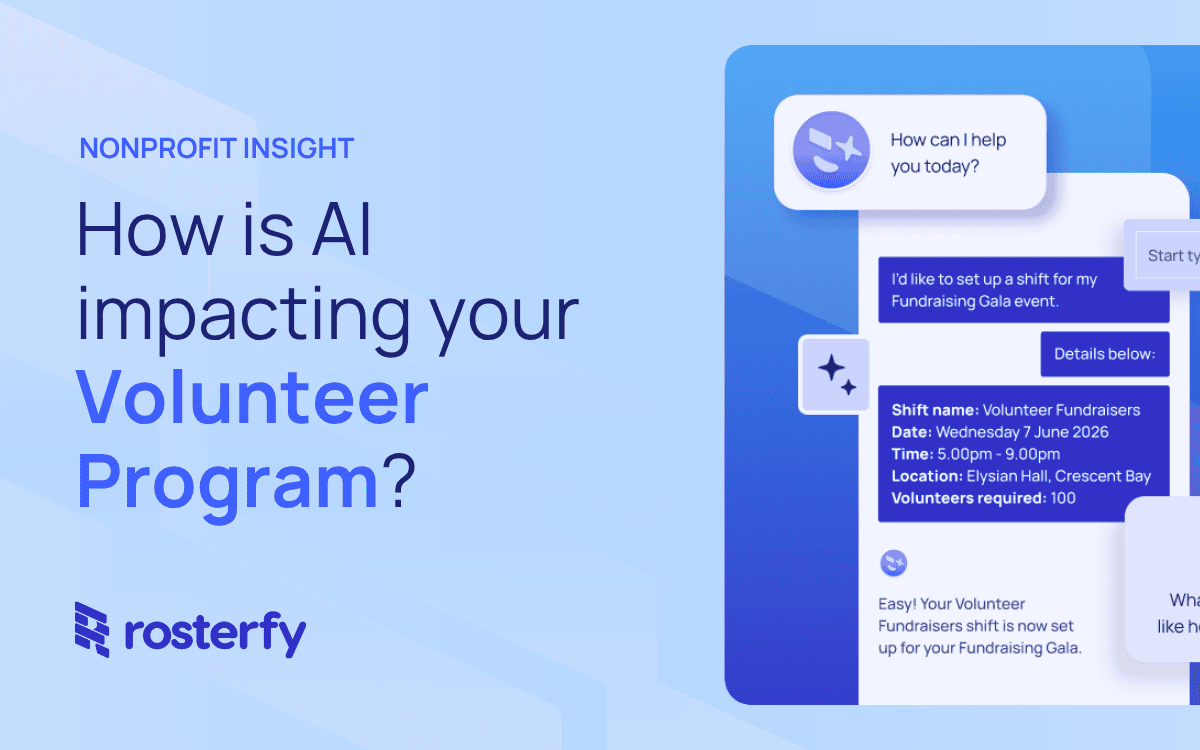
Specialized AI agents built directly into management platforms are changing this dynamic. Rather than requiring users to manually click through complex software menus, AI agents allow administrators to give simple natural-language instructions.
For instance, an administrator can prompt the system: “Create a weekend event for our upcoming food drive, set up three four-hour shifts for five volunteers each, and generate a registration form capturing dietary requirements and emergency contacts.” The AI agent executes the setup in seconds, leaving the coordinator to review and publish.
This is the exact capability Rosterfy has introduced with PIP, an integrated AI agent designed specifically for volunteer managers. PIP translates simple prompt instructions into fully configured shifts, workflows, and web forms within the Rosterfy ecosystem—drastically cutting administrative setup times.
Looking ahead: Embracing smart automation
The rise of AI does not mean replacing human empathy or personal connection; it means freeing up staff so they can dedicate more time to those relationships. By understanding how AI changes discovery, protecting your data with accredited platforms, and leveraging automated agents for routine tasks, your program can scale its community impact without scaling staff burnout.
Want to see how built-in AI tools can simplify your administrative workflows? Register for our upcoming live demonstration, “Hands-on with PIP: How Rosterfy’s AI Agent Can Help You Build an Effective Volunteer Program,” on October 13, and explore practical ways to future-proof your organization.
Martin O’Neill is the Head of Marketing, North America at Rosterfy. A veteran marketing strategist, Martin has spent the last four years helping nonprofits, sports associations, and municipal governments leverage Rosterfy’s volunteer management platform to maximize their community impact.
The views expressed in this article are the author’s alone and do not necessarily represent those of CharityVillage.com or any other individual or entity with whom the authors or website may be affiliated. CharityVillage.com is not liable for any content that may be considered offensive, inappropriate, defamatory, or inaccurate or in breach of third-party rights of privacy, copyright, or trademark.
