
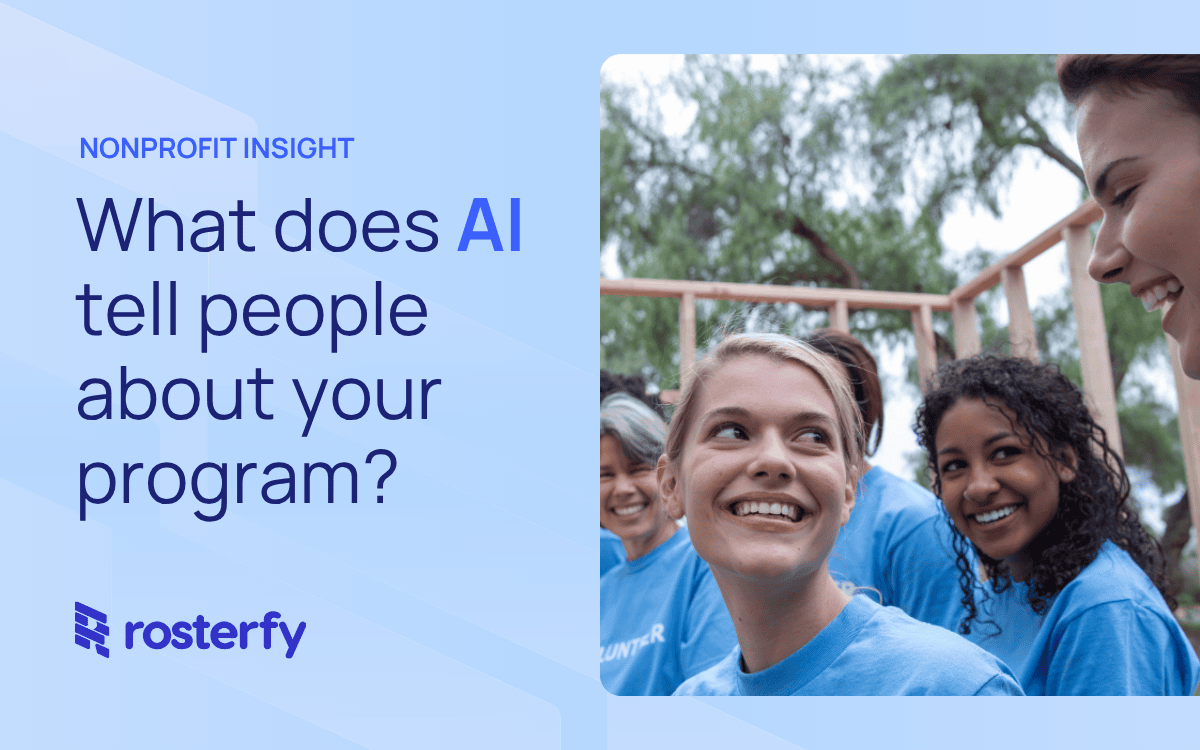

Interested in learning more? We have partnered with Rosterfy to host a free product demo. Register now!
Over the past 18 months, consumer habits around finding information have undergone a permanent shift. Whether booking hotels, comparing consumer goods, or selecting service providers, people are relying less on manual web browsing and more on direct queries powered by Artificial Intelligence.
This transition from traditional “keyword search” to “answer-based search” affects every industry – including the nonprofit sector. When a prospective volunteer asks an AI assistant to recommend a well-run, impactful volunteer program in their city, what answer does the system provide about your organization?
Understanding how AI platforms perceive and summarize your program is critical to maintaining a healthy recruitment pipeline in the modern digital landscape.
The rise of answer-based search in volunteer recruitment
Historically, digital marketing for nonprofits focused on basic Search Engine Optimization (SEO). If your website contained key terms like “food bank volunteer Toronto,” search engines ranked your page, and users clicked through to read your content.
Today, AI models compile information from across the web – including community review platforms, news articles, social media, and third-party directories – to construct direct answers. Instead of giving users a list of websites to evaluate, AI offers a pre-vetted recommendation.
If an AI tool finds outdated program details, unresolved complaints on social channels, or limited public mentions of your organization, it may pass over your program entirely in favour of an organization with a more robust, verified digital footprint.
How to influence what AI says about your program
While you cannot directly edit an AI engine’s algorithm, you can shape the data it consumes. Here are three effective ways to build an accurate digital presence for your volunteer program:
1. Collect and publish volunteer feedback
AI search platforms prioritize recent, verified user experiences. If your volunteers regularly leave positive reviews, testimonials, and public feedback, AI models process that data as a clear sign of program health.
- Action: Build automated feedback touchpoints directly into your volunteer lifecycle. Using Rosterfy’s form builder and automated workflows, prompt volunteers to share testimonials or rate their experience immediately following a completed shift.
2. Keep public role descriptions structured and current
AI language models rely on clear, structured data to understand what your program needs. Vague role descriptions lead to poor indexing.
- Action: Ensure your public landing pages clearly state role requirements, time commitments, locations, and mission outcomes. Structured, transparent role listings make it easy for AI engines to accurately match your positions with volunteer searches.
3. Maintain consistent organizational information
Ensure your organization’s mission, impact metrics, and contact details are consistent across your website, Google Business Profile, CharityVillage directory listing, and social channels. AI systems rely on consistent multi-source verification to determine authority.
Evolving task management: Meet PIP
Adapting to answer-based search is just one piece of modernizing your technology stack. As digital habits evolve outside the office, team expectations inside the workplace are changing just as quickly. Staff members want software tools that reduce administrative friction rather than add to it.
To help volunteer managers adapt to these rising expectations, Rosterfy introduced PIP—an AI-powered assistant designed specifically for task management within the Rosterfy platform.
Instead of navigating complex multi-step processes to configure new events or draft application forms, program leaders can interact with PIP using simple conversational commands. PIP instantly executes tasks such as:
- Setting up multi-shift event schedules.
- Generating customized registration forms with logic fields.
- Creating automated notification rules for upcoming shifts.
By delegating these routine tasks to an intelligent software agent, volunteer coordinators gain back hours every week – time that can be redirected toward volunteer recognition, community partnerships, and strategic growth.
Embracing new tech with confidence and security
While the rapid pace of technological change can feel overwhelming, adopting AI does not require overhauled operations overnight. The most successful nonprofits adopt new tools thoughtfully, at a pace that matches their organizational capacity.
As you evaluate modern tech tools, prioritize data protection and governance. Ensure any platform handling volunteer data holds rigorous, third-party security accreditations such as SOC 2 Type II and ISO 27001. These protocols guarantee that your volunteer data remains secure, private, and fully compliant with privacy laws.
By staying curious, adopting automation responsibly, and actively managing your digital footprint, your program can stay ahead of changing digital habits and deliver even greater impact for your community.
Ready to see AI in action?
To see how PIP and Rosterfy can help streamline your daily operations and future-proof your volunteer program, reserve your spot for our upcoming live demonstration on October 13: Hands-on with PIP: How Rosterfy’s AI Agent Can Help You Build an Effective Volunteer Program.
Martin O’Neill is the Head of Marketing, North America at Rosterfy. A veteran marketing strategist, Martin has spent the last four years helping nonprofits, sports associations, and municipal governments leverage Rosterfy’s volunteer management platform to maximize their community impact.
The views expressed in this article are the author’s alone and do not necessarily represent those of CharityVillage.com or any other individual or entity with whom the authors or website may be affiliated. CharityVillage.com is not liable for any content that may be considered offensive, inappropriate, defamatory, or inaccurate or in breach of third-party rights of privacy, copyright, or trademark.
