
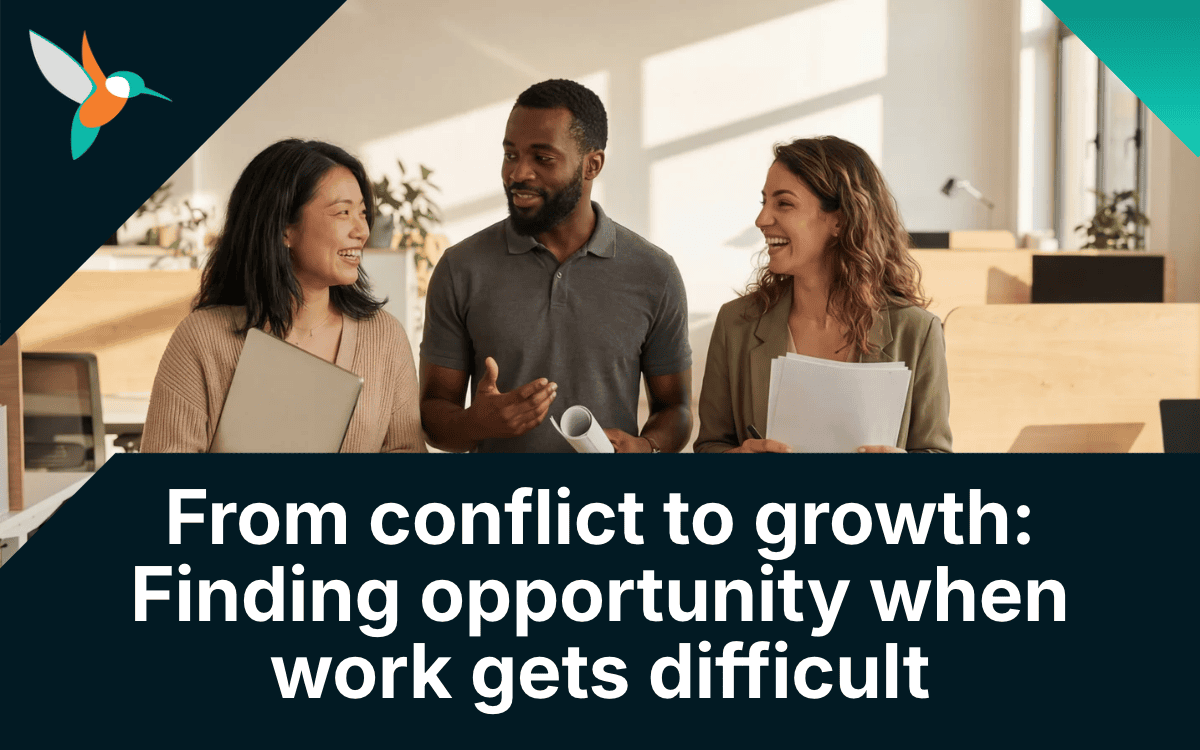

Sometimes, the very challenges that consume our time and energy contain the greatest opportunities for learning, improvement, and growth.
Three articles by Dr. Evan Hoffman explore this idea from different perspectives: helping leaders and professionals turn conflict, competing perspectives, and organizational weaknesses into opportunities to build stronger relationships, more resilient teams, and more effective organizations.
From conflict to clarity: Turning difficult client calls into opportunities
Few workplace experiences are as emotionally draining as dealing with an angry or confrontational client over the phone. In “From Conflict to Clarity,” Hoffman explores what is often happening beneath the surface of an aggressive call.
Anger is frequently a symptom of something else: an unmet need, frustration, uncertainty, or the feeling that someone isn’t being heard.
Rather than responding defensively or trying to “win” the conversation, effective de-escalation begins with staying composed, listening actively, and demonstrating that the other person’s concerns have been heard and understood.
The result can be a remarkable shift from confrontation to collaboration.
Read the full article: From Conflict to Clarity: De-escalating Confrontational Calls.
Multiple truths, one team: Understanding different worldviews
What happens when two people look at exactly the same situation but see something completely different?
In “Multiple Truths, One Team,” Hoffman examines how different experiences, values, assumptions, and worldviews can shape the way colleagues interpret workplace events.
The challenge isn’t necessarily determining who is “right.”
Instead, effective teams learn to become curious about why people see things differently.
Creating space for “multiple truths” and engaging in courageous conversations can help teams move beyond defensiveness and toward understanding.
When people feel heard even when their perspectives aren’t shared, trust grows. And when trust grows, collaboration becomes possible.
Read the full article: Multiple Truths, One Team: Navigating Divergent Worldviews at Work.
Unlocking synergy: Turning organizational weaknesses into opportunities
Sometimes the biggest opportunity isn’t visible at the level of individual interactions. It emerges when leaders step back and examine how different parts of the organization interact.
In “Unlocking Synergy,” Hoffman combines the familiar SWOT analysis (strengths, weaknesses, opportunities, and threats) with systems thinking to provide a more nuanced and complete strategic perspective.
A traditional SWOT analysis can identify an organization’s internal strengths and weaknesses alongside external opportunities and threats. Systems thinking takes the analysis one step further by asking an important question: How do these factors interact with one another?
An internal weakness may amplify an external threat, creating a situation that requires immediate damage control. But that same analysis can reveal something else: a fleeting “golden opportunity” where an organizational strength aligns perfectly with a change in the external environment.
The objective is to go beyond cataloguing problems to understanding the relationships between them and using that understanding to make better strategic decisions.
Three challenges. Three opportunities.
Taken together, these three articles offer a useful way of thinking about organizational growth.
The common thread is perspective:
- Leaders don’t always have control over the challenges that emerge around them. They can, however, influence how those challenges are understood and how people respond to them.
- The angry caller may be communicating an unmet need.
- The disagreeing colleague may be seeing something you aren’t.
- The organizational weakness you’ve been avoiding may reveal exactly where change is needed, and where an unexpected opportunity is waiting.
Look again at the problems in front of you
The next time your team encounters a difficult client, a seemingly unresolvable disagreement, or a weakness that keeps appearing on the strategic agenda, consider asking a different question:
What if this problem isn’t simply something we need to solve? What if it is also telling us something we need to learn?
That shift from problem-solving alone to learning, understanding, and opportunity recognition can change the way organizations approach conflict, collaboration, and strategy.
Sometimes, your next breakthrough isn’t somewhere outside the organization.
It may already be hiding inside the problem you’ve been trying to solve.
Evan Hoffman, PhD is a conflict resolution specialist with deep roots in the social services and human support fields. He has spent more than two decades helping individuals and organizations navigate high-stress situations with empathy, clarity, and respect.
Evan has led and supported initiatives that strengthen communication, trust, and collaboration across sectors from social service agencies and Indigenous organizations to international institutions such as the UN and Global Affairs Canada.
Today, Evan combines his experience as an educator and practitioner to help others build resilient relationships and manage conflict constructively. Whether working with front-line staff, managers, or community leaders, he focuses on developing the skills and confidence people need to respond to conflict with compassion and effectiveness.
Visit www.ConflictDoctor.ca to learn more about his background and current work.
The views expressed in this article are the author’s alone and do not necessarily represent those of CharityVillage.com or any other individual or entity with whom the authors or website may be affiliated. CharityVillage.com is not liable for any content that may be considered offensive, inappropriate, defamatory, or inaccurate or in breach of third-party rights of privacy, copyright, or trademark.
