
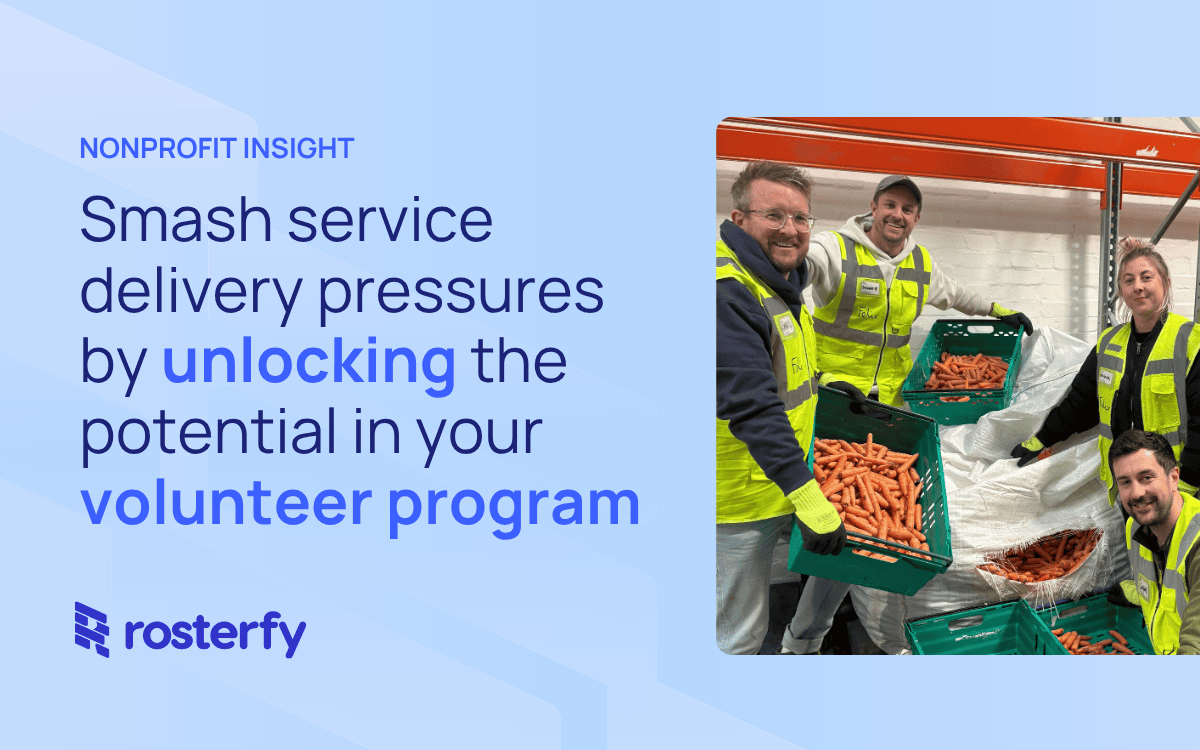

Interested in learning more? We have partnered with Rosterfy to host a free webinar. Register now!
The Canadian nonprofit sector is facing a compound challenge. According to recent sector research from Volunteer Canada and Statistics Canada, over 65% of nonprofit organizations report a significant increase in demand for their services. At the same time, traditional volunteer pools are shifting, leaving teams understaffed and stretched to capacity.
Simultaneously, the economic value of volunteer contributions has never been clearer. Independent sector estimates place the average value of a single volunteer hour at roughly $47. Every hour dedicated by a volunteer represents a tangible contribution directly bolstering an organization’s bottom line and operational capabilities.
Yet despite these realities, a persistent gap remains. Many nonprofits – even those that explicitly identify volunteers as core to their mission – struggle to invest adequately in their people and systems. They continue to run modern programs on outdated processes, bottlenecking their own service delivery capabilities.
Do you make it difficult for volunteers?
In a recent industry-wide survey conducted by Rosterfy, 92% of nonprofit leaders agreed that volunteers are “mission-critical” to their organization’s success. However, that same research highlighted a glaring vulnerability: many organizations lack an efficient, welcoming onboarding and application pipeline.
When prospective volunteers encounter clunky application forms, slow response times, or manual background verification steps, drop-off rates surge. An interested volunteer who waits two weeks for a response will often look elsewhere or disengage entirely. By failing to streamline the initial touchpoint, organizations turn away vital support before a volunteer ever sets foot in the field.
Conversely, organizations that treat the volunteer user experience with the same care as donor acquisition are reaping significant rewards. Investing in a modern, seamless digital onboarding workflow establishes trust immediately, turns interest into active participation, and builds a resilient community of supporters.
Case Study: Scaling Impact at Alzheimer Society of BC
To see what happens when an organization aligns modern technology with clear strategic vision, consider the Alzheimer Society of British Columbia. Facing ambitious fundraising and service delivery goals, the organization recognized that its legacy administration systems could not support its growth plans across the province.
The Alzheimer Society of BC partnered with Rosterfy to standardize and modernize its volunteer operations. The goal was twofold: streamline internal administrative overhead and create a frictionless, modern experience for volunteers across regional events and ongoing support roles.
The results were transformative:
- Expanded regional reach: The organization scaled its signature programs across 19 unique event locations without adding excessive administrative headcount.
- Increased retention: Clear automated communication pathways reduced volunteer attrition, making re-engagement for multi-year events simple and reliable.
- Operational confidence: Local coordinators moved away from spreadsheet tracking and into centralized, real-time management.
As Matt Brookes, Provincial Configuration Lead at Alzheimer Society of BC, noted:
“In terms of scalability, if we had to add new walk locations, I wouldn’t even consider the administrative task because I know Rosterfy can incorporate them. There’s no fear of scaling because the platform grows with our needs.”
By removing the friction from shift scheduling, communication, and background tracking, the Society unlocked the true capacity of its volunteer base—directly supporting those impacted by dementia.
Four operational pillars to maximize program potential
If your organization is working to meet rising demand, consider these foundational adjustments:
- Audit your application journey: Test your signup process on a mobile device. If it takes longer than five minutes or requires manual data entry from staff before a volunteer receives a response, it needs optimization.
- Automate routine communication: Use automated confirmations, shift reminders, and post-event thank-you emails to maintain strong volunteer engagement without consuming staff time.
- Empower self-service: Allow volunteers to manage their own schedules, update personal details, and upload certifications through a central online portal.
- Leverage data for resource allocation: Track shift completion rates, volunteer hours, and attendance trends in real time to identify operational gaps early.
Join the conversation
Overcoming service delivery pressures requires rethinking how we acquire, engage, and retain volunteer talent. Rosterfy is hosting a live webinar on September 10 featuring insights from sector experts on turning volunteer operations into strategic assets.
For practical strategies on optimizing your recruitment pipeline right away, download our free resource, The Volunteer Recruitment Playbook (North America Edition). You can also read the full Alzheimer Society of BC Case Study to explore detailed strategies for scaling your community footprint.
Martin O’Neill is the Head of Marketing, North America at Rosterfy. A veteran marketing strategist, Martin has spent the last four years helping nonprofits, sports associations, and municipal governments leverage Rosterfy’s volunteer management platform to maximize their community impact.
The views expressed in this article are the author’s alone and do not necessarily represent those of CharityVillage.com or any other individual or entity with whom the authors or website may be affiliated. CharityVillage.com is not liable for any content that may be considered offensive, inappropriate, defamatory, or inaccurate or in breach of third-party rights of privacy, copyright, or trademark.
