


Ask a nonprofit leader where their organization’s revenue comes from, and you’ll probably hear a familiar list: grants, donations, fundraising events, perhaps a government contract or two.
Ask what would happen if one of those disappeared, and the conversation quickly changes.
For many organizations, the challenge is no longer simply raising more money. It’s becoming less dependent on any single source of funding.
Across Canada, nonprofit leaders are navigating rising demand, increasing operating costs, greater competition for grants, and funding models that often fail to cover the true cost of delivering programs. Traditional funding remains essential, but relying too heavily on one revenue source creates unnecessary risk.
That’s why revenue diversification for nonprofits has become such an important conversation. It isn’t about replacing grants or turning every nonprofit into a social enterprise. It’s about building a healthier mix of nonprofit revenue strategies that strengthens financial resilience over time.
At Thriving Non-Profits, we organize that mix into three complementary categories: traditional revenue, earned revenue, and entrepreneurial strategies.
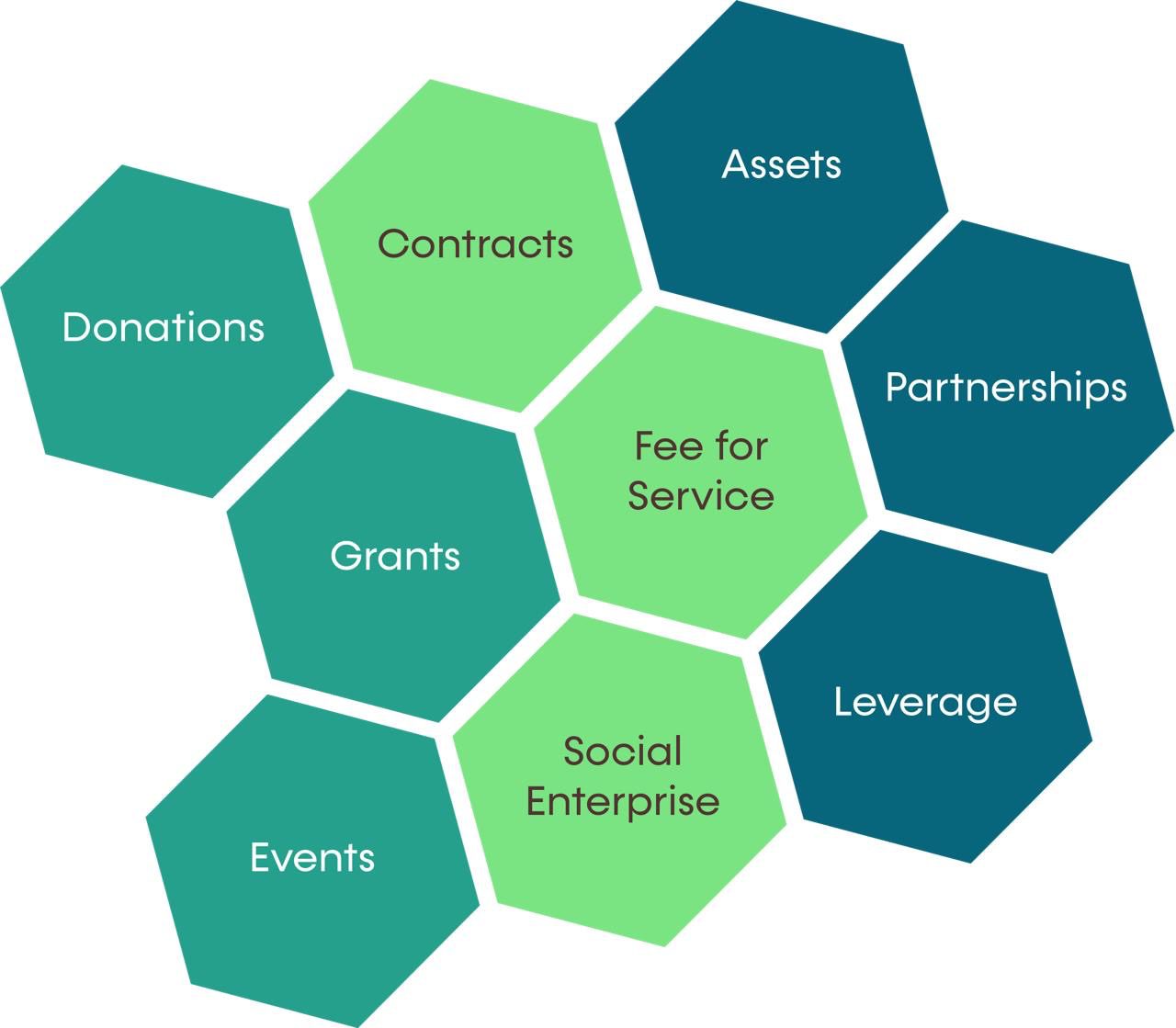
Together, they form a practical framework for revenue diversification for nonprofits, helping organizations reduce risk while building stronger, more resilient revenue streams. Think of it like an investment portfolio. Healthy portfolios don’t depend on a single asset, and resilient nonprofits shouldn’t depend on a single source of revenue.
Strengthen your traditional nonprofit revenue strategies
Revenue diversification doesn’t always begin by creating something new. Often, the greatest opportunity is making your existing revenue work harder.
Donations, grants, contracts, and fundraising events remain the foundation of most nonprofit funding strategies. The opportunity is not simply finding new revenue, but strengthening the revenue streams you already have. Rather than treating each independently, consider how they can work together to strengthen long-term resilience.
For example, not every grant delivers the same return. Some fund current activities. Others help build future capacity by supporting new programs, investing in systems, strengthening staff capability, or creating future earned revenue.
The same thinking applies to fundraising events. Instead of measuring success only by dollars raised on the night, consider the broader return. Did the event introduce new donors? Strengthen relationships with sponsors? Increase public awareness? Recruit volunteers? Generate earned income? Build future partnerships? Looking beyond ticket sales often reveals much greater long-term value.
Earned revenue: One of the most effective nonprofit revenue strategies
For many nonprofit leaders, earned revenue raises an immediate concern: how do we charge for services without compromising accessibility or our values?
A better question is, “Who benefits from the value we create, and who has the ability to pay?”
The people who pay may not always be the people who benefit. Employers, schools, health authorities, governments, and other nonprofits may all value the outcomes your organization creates.
Fee-for-service is one of the most flexible nonprofit revenue strategies because it allows organizations to build on expertise they already have while protecting accessibility through different pricing approaches. The strategy can also use many pricing models, including memberships, sliding scales, subsidized pricing, voluntary contributions, or fixed fees, depending on your mission and community.
Social enterprise is different
While fee-for-service complements existing programs and services, social enterprises tend to operate as independent businesses within or owned by an organization. It combines a business model with a social, environmental, or cultural purpose, reinvesting profits to advance your mission.
Before pursuing a social enterprise, organizations should assess their organizational, business, and social enterprise readiness, and consider whether building or acquiring a business is the stronger path.
Earned revenue works best when it grows from a clear understanding of what the organization already does well, who values that work, and how its mission can be embedded while supporting a stronger overall financial model.
Look beyond earned revenue to uncover hidden opportunities
When nonprofit leaders think about revenue diversification, the conversation often jumps straight to fee-for-service or social enterprise.
Those are important strategies, but they aren’t the only ones available. Many of the strongest revenue diversification strategies begin by making better use of assets an organization already has.
Think beyond cash reserves and property. Your staff’s expertise, volunteers, facilities, equipment, networks, reputation, intellectual property, community trust, and even underused space all represent assets with the potential to create value.
The conversation shifts from focusing on what your organization lacks to recognizing the value it already has. When organizations begin to see assets differently, they stop asking, “What new program should we build?” and start asking, “What strengths do we already have that could create more value?”
For example, a nonprofit that regularly develops educational resources may have opportunities to license content or deliver professional development. An organization with meeting space may be able to rent it during unused hours.
Partnerships: Lead with the value you bring, not the other way around
Strong partnerships are built on shared value, not shared need. Rather than focusing only on what a potential partner can bring to your organization, start by understanding the value your organization brings to them. That could be your expertise, community trust, brand, reach, relationships, or ability to create meaningful social impact.
From there, look for organizations where there is genuine alignment between your shared mission and objectives. Develop a clear value proposition that explains why working together benefits both organizations.
When partnerships are built around a true “win-win,” they become more than a source of funding. They become a long-term strategy for increasing impact, expanding reach, strengthening capacity, and creating new opportunities for everyone involved.
Leverage your operations to support your mission (and the sector!)
The final strategy asks leaders to think beyond revenue generation and consider how every part of their organization can advance its mission.
Most nonprofits focus on creating impact through their programs and services. In Thriving Non-Profits, leverage expands that thinking by encouraging organizations to align their activities, employment, purchasing, banking, and investments with the change they want to create. This is what we call 100% alignment.
Canada’s nonprofit sector employs millions of people and contributes billions of dollars to the economy each year. By intentionally aligning every part of your organization’s operations with its mission, you can increase your impact while helping strengthen the broader nonprofit sector.
Choose the right nonprofit revenue strategies for your organization
Perhaps the most important lesson about revenue diversification for nonprofits is that there is no one-size-fits-all approach. Every organization should align its revenue strategies with its mission, capacity, and objectives. Start by asking five practical questions about each opportunity you identify:
- Time: How quickly do you need results?
- Culture: Does the opportunity fit your organization’s values and appetite for change?
- Risk and return: Is the potential benefit worth the investment and uncertainty?
- Strengths and resources: Do you already have the capabilities, capacity, and assets to succeed?
- Impact: Most importantly, will this strengthen your mission as well as your finances?
These questions help move the conversation beyond “Is this a good idea?” toward “Is this the right strategy for our organization, right now?”
The most resilient nonprofits are rarely those with the most funding. More often, they are the organizations that understand their strengths, make thoughtful choices about where to invest their energy, and build a revenue mix that can adapt as their communities and the funding landscape continue to evolve.
Start your organization’s revenue diversification journey
Our upcoming seminar, Beyond Grants: Build a Diversified Revenue Plan for Long-Term Sustainability, will introduce a practical approach to revenue diversification that helps organizations strengthen financial resilience without losing sight of their mission.
On September 23, participants will explore how organizational culture, beliefs about money, and attitudes toward risk can influence decision-making, and learn how a combination of traditional and entrepreneurial revenue strategies can create greater stability, flexibility, and impact. Register now.
The views expressed in this article are the author’s alone and do not necessarily represent those of CharityVillage.com or any other individual or entity with whom the authors or website may be affiliated. CharityVillage.com is not liable for any content that may be considered offensive, inappropriate, defamatory, or inaccurate or in breach of third-party rights of privacy, copyright, or trademark.
