
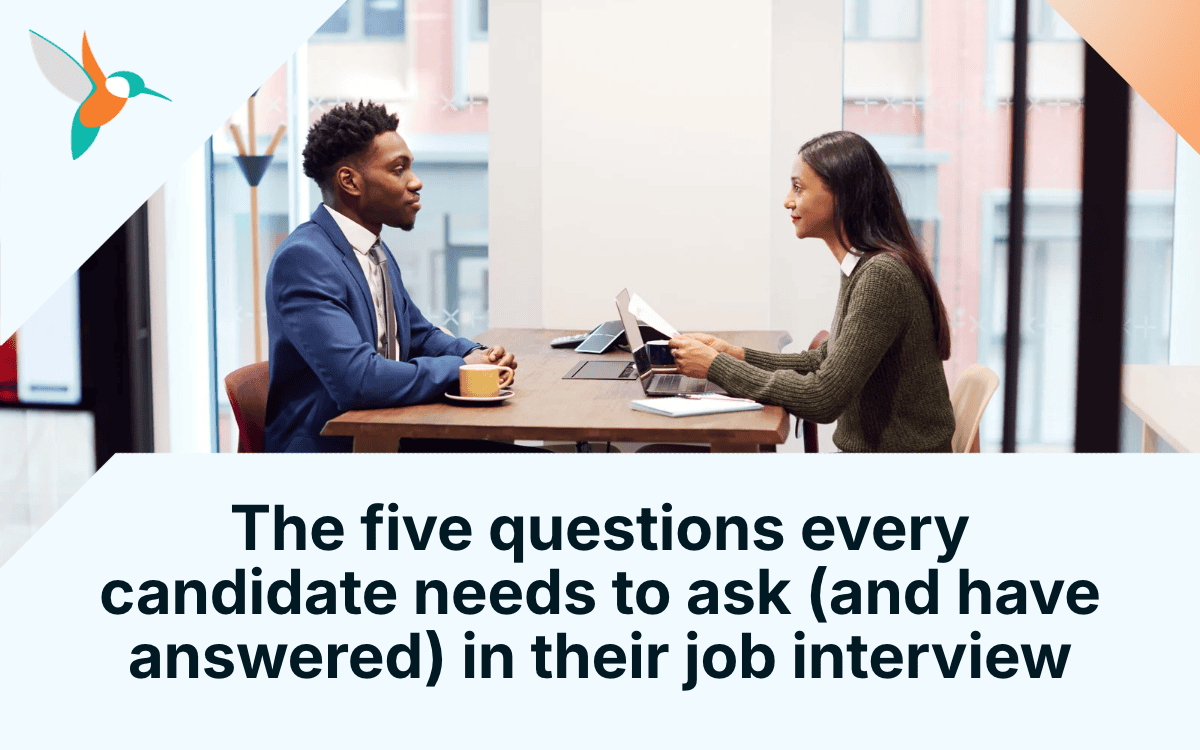

The interviewer is winding down the job interview. You can tell. They look like they have asked all the questions on their list. They are double-checking their notes and then, they turn to you and ask the dreaded question, “So, do you have any questions for me?”
Perhaps you freeze in that moment. Or you ask a detailed but awkward question about money or benefits. Maybe you don’t know what to ask. You want to gain a keener sense of how the organization functions, how people are treated, and what you will experience if you accept an offer, but you are unsure of how to approach these topics in a professional way.
In any job interview, the interviewer is trying to imagine the candidate in the role. They know the workplace, the people, the workflow, the problems, the challenges, and the joys of working in that environment. On the flip side, you also want to be able to imagine yourself in the role, understanding what it will look like to do the job in the actual workplace environment. To do that, you might need to ask a few questions.
Here are five questions that aim to help you gain as much insight as possible into your potential employer. Why ask these questions? They are designed to help you engage with the interviewer in a professional but informal way that gives you the opportunity to find out about the organization before you proceed further in the hiring process.
Question #1: What has led to this role being available?
If this information has already been provided to you during the interview, then it is not necessary to ask this question, and you can carry on with other questions. Candidates will likely feel very different if the answer is that the employee moved provinces to be with family or was promoted within the organization versus if the answer is that they left suddenly or went on leave and have not returned, either of which could be a possible red flag.
Question #2: Could you please describe the reporting structure around this role?
This question may lead to follow-up questions such as: Who does the role report into? How many other colleagues are at my supervisor’s level?
And for yourself, “How many colleagues are in my role in the organization?”
This question can help you gain a better understanding of the structure above, at, and below your role.
Question #3: What are the top priorities waiting on the desk of the successful candidate?
We all want to know what day 1 and day 15 and day 32 look like in the role. The answer to this question gives you a sense of the priorities and activities that will need to be addressed in the first 30 – 90 days on the job. With this question, you may learn that a big annual event is coming up and it will take up much of your time, or you might learn that a new product launch will be your first order of business in the role.
Question #4: How would you describe the organizational culture in a few words?
How an interviewer chooses to answer this question tells you a lot about the organization and its perception of its culture. An interviewer may struggle a little to offer a brief description of the organizational culture because it requires them to recall how people are treated in good and difficult times. They may recall a challenging issue that was overcome, or discuss some of the organization’s professed values. The answer to this question can give you strong insight into how the organization expects people to behave – and what qualities they value in their employees’ behaviour. It may also provide clues as to how the organization treats its staff.
Question #5: How do we celebrate wins/successes in the organization?
This is your last question, and it is a feel-good question. It should be quite easy for the interviewer to answer. It gives them a high note to go out on in the interview. It winds down the interview time in a positive and optimistic manner. With this answer you may hear about reward programs, benefits, or additional informal ways that wins have been celebrated in the past.
So, if these questions give us more insight, why don’t candidates ask them? Sometimes people are too nervous or, perhaps they don’t want to appear difficult. However, there is many a candidate who left an interview without asking questions, accepted a job offer, and then faced a few surprises in their first days on the job. You owe it to yourself to know what you are walking into in a work environment. And remember, in any job interview, you are assessing the organization’s fit for you (culture, organizational structure, pace, etc.) as much as the interviewer is assessing your fit for the organization.
Sonia Byrne, CHRL is an organizational consultant whose work focuses on building sustainable leadership practices and teambuilding experiences to support organizational stability in times of change, chaos, and uncertainty. Sonia has been providing leadership consulting, team retreat experiences, and conference workshops in the non-profit sector since 2009.
The views expressed in this article are the author’s alone and do not necessarily represent those of CharityVillage.com or any other individual or entity with whom the authors or website may be affiliated. CharityVillage.com is not liable for any content that may be considered offensive, inappropriate, defamatory, or inaccurate or in breach of third-party rights of privacy, copyright, or trademark.
