

Interested in learning more? We have partnered with Rosterfy to host a free webinar. Register now!
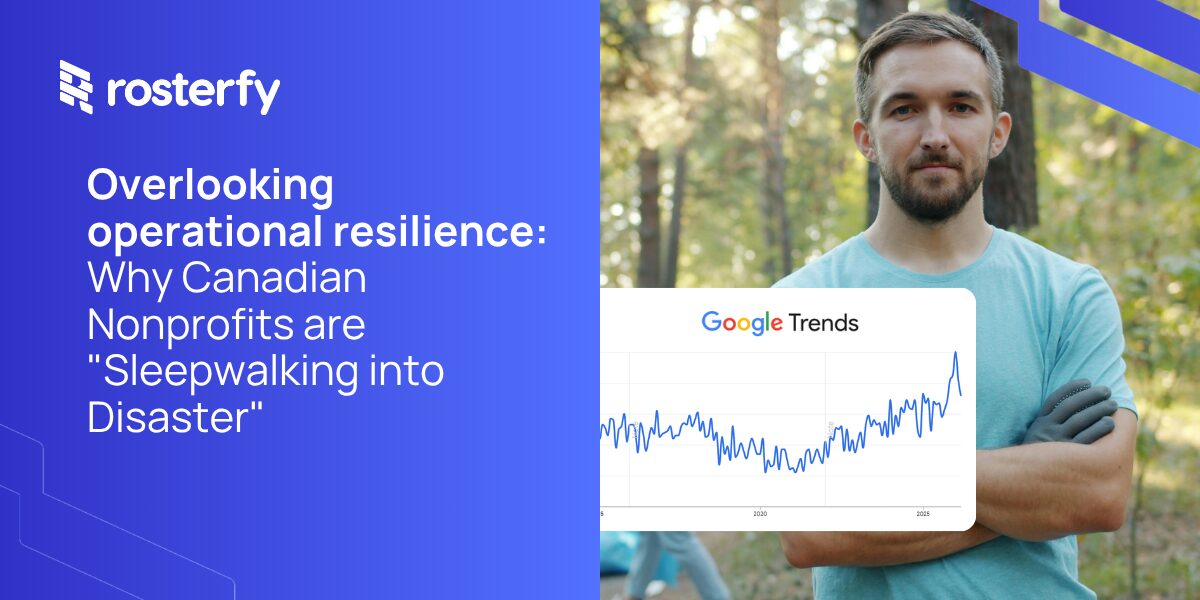
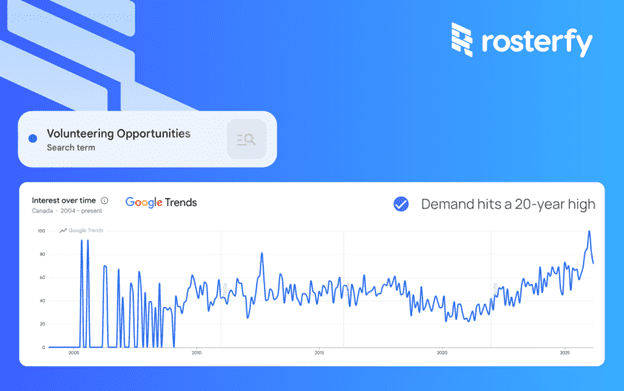
The Canadian nonprofit sector is facing a startling paradox. The data suggests there’s massive interest in giving back – in fact, it has never been higher. According to Google Search Trends, queries for “volunteering opportunities” in Canada have hit an all-time high in 2026, surpassing even the most optimistic post-pandemic recovery projections.
On the surface, this looks like a golden age for community impact. But beneath that surface, something sinister is lurking. While the demand for services and the supply of willing hands are both rising, the operational infrastructure of nonprofit organizations is reaching a breaking point.
We are no longer in an era where “getting by” with manual processes is just an inconvenience. In 2026, a lack of Operational Resilience is becoming a primary risk to mission success. Many organizations are sleepwalking into a disaster where their most valuable asset – their people – are being crushed by the weight of outdated systems and inconsistent accountability.
The invisible bottleneck
Operational resilience is the ability of an organization to absorb strain, recover from disruption, and adapt to changing environments. For a nonprofit, this resilience is rooted in both how effectively it manages its volunteer workforce and how it can navigate rising operational costs.
However, as we look at the current landscape, three distinct cracks have appeared in the foundation of the sector:
1. The admin imbalance: When a volunteer manager spends most of their week on manual data entry, compliance follow-ups, and digging through spreadsheets, that’s time stolen from the mission. We see teams stuck in “The Admin Trap,” where the sheer volume of paperwork creates a bottleneck that prevents eager volunteers from actually getting into the field.
Canadians expect a seamless digital experience, not a clunky onboarding process. If your onboarding takes three weeks of back-and-forth emails, a modern volunteer will have moved on to a more agile organization within three days. You aren’t just losing a volunteer; you are losing the service delivery they would have provided.
2. You’re losing talent: We often talk about the “volunteer experience,” but we rarely talk about the “manager experience.” The staff volunteer coordinators and managers are the support network for the entire organization. Right now, they are facing burnout.
When we force our top talent to work like low-level data processors because of “Legacy VMS” or “Old-School Spreadsheets,” we drain their professional passion. When a coordinator leaves the sector due to exhaustion, they don’t just leave a vacancy; they take years of community trust and institutional knowledge with them.
I always think of it like this – ‘no one joins a charity to do their paperwork’.
3. The accountability gap: In many organizations, the “ownership” of the volunteer program is fragmented. Is it HR? Is it Operations? Is it Fundraising? When Rosterfy ran last year’s State of Volunteer Management Survey, we asked this question, and there was no clear answer.
This inconsistent allocation of accountability leads to confusion over the program’s actual impact. Without a centralized source of truth, it becomes impossible to prove the ROI of volunteering to a board of directors. Without data, volunteering is treated as a “nice to have” peripheral activity rather than the critical driver of fundraising and service delivery that it actually is – is it any wonder there’s little investment made into it?
The “scalability tax”
Many organizations believe they are saving money by sticking with manual processes or free, basic tools. In reality, they are paying a “Scalability Tax.” This is the hidden cost of growth. As your volunteer pool grows, the complexity of managing them grows exponentially, not linearly.
If it takes one hour of admin to manage ten volunteers, it might take ten hours of admin to manage fifty – but by the time you reach five hundred, the manual system or entry-level VMS collapses entirely.
Compliance risks skyrocket, data privacy (PIPEDA) becomes harder to manage, and the risk of a “vulnerable sector” check falling through the cracks becomes a terrifying possibility.
Real operational resilience means having an infrastructure that handles 5000 volunteers, donors and supporters as easily as 50.
From survival to scalability: The Rosterfy approach
First, accept the new world reality – what you’re seeing isn’t sustainable.
Canadian nonprofits must move from reactive to proactive. This requires a shift in how we view volunteering as a whole service – it means investing in the future.
This is where Rosterfy enters the conversation. The sector is crying out for a platform that won’t just schedule people or send emails. What’s needed is a scalable solution designed to automate the heavy lifting of recruitment, scheduling, and compliance. By automating the “boring” parts of the job, we give the gift of time back to the people who need it most.
Resilience means having real-time data that shows exactly how volunteering is driving your mission. It means creating a professional, seamless experience for the volunteer that reflects the quality of your brand. Most importantly, it means protecting your staff from the burnout that comes with administrative chaos.
Now it’s down to you
The surge in interest shown in our 2026 search data is a massive opportunity, but it’s also a stress test. Organizations that choose to future-proof their programs today will be the ones that thrive. Those that stay tethered to the “way we’ve always done it” will find themselves unable to meet the needs of their community or the expectations of their staff.
We have a choice: we can continue to let admin bottlenecks dictate our impact, or we can build a resilient, tech-forward foundation that allows our missions to soar.
The benefits of transforming your program are right under your nose – with more demand for volunteering positions, it opens the door for more donations, more services delivered, more families fed, protected, rehomed or healed. Everything starts with volunteers and ends with how effectively you can manage your program.
Join the conversation: The 2026 State of Volunteering Survey
To truly understand the scale of these challenges and find a collective path forward, we need your voice. Rosterfy is currently conducting a comprehensive study on the hurdles facing our sector today.
Contribute to the State of Canadian Volunteer Management 2026 Survey here.
By sharing your experiences, you can help the Canadian nonprofit sector create a clearer picture of how we can build a more resilient future.
About the Author
Martin O’Neill is Head of Marketing for North America at Rosterfy. He works with nonprofits, city-wide programs, sports associations and major events to discover a more effective way to mobilize and engage large communities of volunteers. Martin channels a background of nearly 20 years in marketing and growing businesses to elevate the awareness of Rosterfy to the North American region.
Rosterfy is a global leader in volunteer management software, dedicated to connecting communities to events and causes they thrive in. Their platform helps organizations across Canada reduce admin time, improve compliance, and scale their impact through better volunteer engagement. Learn more at www.rosterfy.com.
The views expressed in this article are the author’s alone and do not necessarily represent those of CharityVillage.com or any other individual or entity with whom the authors or website may be affiliated. CharityVillage.com is not liable for any content that may be considered offensive, inappropriate, defamatory, or inaccurate or in breach of third-party rights of privacy, copyright, or trademark.
