


Want to learn more about storytelling for fundraising success? Watch the accompanying webinar recording.
Fundraisers today operate in a complex and fast-paced multi-channel world. Communications technology changes weekly – and we all know what a struggle it can be to keep up with it. The human brain on the other hand, hasn’t changed much over the past few thousands of years. No matter what channels you fundraise in, telling great stories is still your ticket to great revenue results.
You may not know it, but 1990 was a pivotal year for fundraisers. That year started the decade that DOUBLED our understanding of how the human brain actually thinks, feels and makes decisions. You see, the 1990s was the decade when the MRI machine began mapping the human brain and illustrating what the brain was doing as it performed different functions.
Not only did our knowledge of the human brain double in the 1990s. It doubled again in the decade between 2000 and 2010 – and it’s doubling again in the decade that’s coming to an end now. When you put it all together, we know 8 times more about the brain than we did just thirty years ago.
All of this neuroscience has proven one thing that many of us believed intuitively before 1990. Storytelling is the most powerful way that we humans entertain, educate and connect with each other.
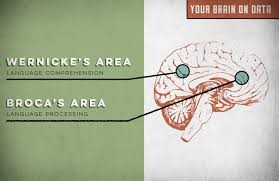
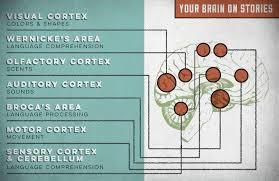
Check out these two images. The one on the left shows your brain when you’re looking at the graphs, charts and tables in your annual report. Sure, your brain is doing something, but it’s not all that much. The image on the right on the other hand shows your brain as you’re reading a story in that same annual report. It’s busy and engaged all over the place. And every fundraiser knows that donor engagement is the name of the game.
While specific dates are unsure, anthropologists estimate that humans have used language for about 2 million years. And, as soon as we had words, we started telling stories. The reason for this is simple – stories helped us survive. Stories allowed cave dwellers to teach their children about dangers. Storytelling could point out food sources. Stories helped pass the dark hours around the fire. And, as we humans are the most social of all animals, stories helped forge and strengthen relationships within families, hunting groups and tribes.
Perhaps American novelist Ursula Le Guin said it best: “The story – from Rumpelstiltskin to War and Peace – is one of the basic tools invented by the mind of man, for the purpose of gaining understanding. There have been great societies that did not use the wheel, but there have been no societies that did not tell stories.”
Stop for a minute and think of your brain as a personal computer. Now consider the fact that an appetite for telling and listening to stories is one of the most powerful software applications in your brain computer. We are indeed hard-wired for storytelling…
So now that you’re motivated to tell your donors and prospects superb stories, how exactly do you go about it? My fellow Good Workers and I have been storytelling for decades, and after a lot of thought and debate, we’ve narrowed our list down to 8 key elements that will bring your story to life.
Here they are:
1. PROTAGONIST: If you were going to ‘draw’ your story before writing it, I’d ask you to consider your protagonist as the hub of a wheel – and the other elements as the spokes. Your protagonist is the lead character in your story – the one the story is about. In many cases, you could choose from a list when considering your protagonist. For example, a hospital surgery story could be told from the point of view of the patient, the patient’s spouse, the surgeon, a nurse or even the person who delivers meals in post-op. When you’re choosing your protagonist, you want to select the one who your audience will identify with so that they can share his or her experience.
2. CAST OF CHARACTERS: The cast is the group of people – sometimes large and sometimes small – that surrounds your protagonist. The cast offers the protagonist the opportunity to relate and react and show more character depth. In classic storytelling, the cast might include a sidekick, a love interest, a villain or a mentor. Your list can go on to include a victim, a rescuer, a supernatural force – there’s no limit to who might be in your cast of characters.
3. THE JOURNEY: Now the story gets interesting! Pretty much every story I know has the protagonist setting off in search of something. To find love. To right a wrong. To learn or grow. To discover. To fight a foe. Think of your story’s journey as the map on which your story will take place. For fundraisers, the story’s journey could be an abandoned cat’s search for a loving home, a quest for a successful cancer outcome or a parent’s dream of a well-educated child.
4. NEMESIS: Any great story has a character or a force that works against the desire of the protagonist. Often, the nemesis takes the form of a villain – but in philanthropy, the nemesis can be something bigger than a single character. Your nemesis could be cancer or greed or hunger or illiteracy. In many fundraising story-writing cases, the nemesis is the essence of your cause. Whether your organization exists to find a cure for muscular dystrophy or get high school dropouts to go back to school or find homes for abandoned cats, your nemesis is the defining root of your cause.
5. EMOTIONS & SENSES: As storytellers, we breathe life into our tales when we involve our audience’s emotions and senses. Can you trigger feelings of anger, fear, sadness or happiness? Can you cause your audience to smell a pie baking in the kitchen, see the sadness in the eyes of another, taste a salty tear on the corner of the lips? Neuro research has shown that when the story is told effectively, audience members actually do feel and taste and smell. This is how you bring your story to life in the brains of your donors.
6. DEFINING MOMENT: In a truly great story, there’s a singular moment when everything changes. It’s the climactic event where your story reaches its full crescendo. In the Wizard of Oz, it’s Dorothy clicking the heels of her red shoes and finding herself back in Kansas. In the Lord of the Rings, it’s Frodo throwing the Ring back into the fires of Mount Doom from whence it came. In A Christmas Carol, it’s Ebenezer Scrooge waking up on Christmas morning and realizing that he’d only been dreaming. Try if you can to create one moment – one scene – one interaction – where your audience is going to be 100% on the edge of their seats waiting to see how things turn out.
7. RESOLUTION: In classic storytelling, the climax is followed by a resolution. After throwing the Ring into the fire, Frodo returns home to the peace and tranquility of his home in the Shire. Scrooge buys a turkey and has it delivered to Bob Cratchit’s house for Christmas dinner. The story ends with the tension of the climax resolved and (often) your protagonist lives happily ever after.
Having said that, the stories that we tell to doors often aren’t yet resolved. Someone is still waiting for an organ transplant. A puppy is still in a shelter waiting for a forever home. Someone with a genetic disease is still hoping that research will find a cure before it’s too late. In these cases, you don’t resolve the story – but you invite the donor to. When you invite the donor to create the ‘happily ever after’ ending – you’re getting her even more involved in your cause and your mission. And that is what great philanthropic storytelling is all about!
8. IMPULSE TO ACT: This is the step that is different for fundraisers than for most other storytellers. Most writers want to leave their audience in a certain emotional state – like peaceful or fired-up or romantic. As fundraisers, we don’t just want our audiences to FEEL something – we want them to DO something. When we craft powerful stories, our call to action – whether implied or explicitly stated – is irresistible to the donor. And triggering that action is why you created your story in the first place!
Your story is perfect when…
When you employ these 8 elements well, you create a bridge that takes your audience member from being a witness to your story to being a participant in it. This is what literary critics call ‘the suspension of disbelief’. When this is achieved, your reader or listener becomes totally engrossed in the protagonist’s experience because it becomes her virtual experience.
If you think for a moment of a story you really love – whether it’s a movie, a novel or a tale your mother told you at bedtime – you’ll realize that you didn’t just observe that story. You became a part of it. The story became your story. This is the magic of narrative – and this is why storytelling is the most powerful means of communication we have after 2 million years of human history.
So, try this next time…
When you’re getting ready to write your next story for your donors and supporters, sit down and create an outline. Set it up like a wheel with your protagonist at the centre and the other 7 elements as your spokes. Then think about – and jot down – how your story will be structured.
I’m pretty sure you’ll be happy with the way it all turns out!
Fraser Green is a Chief Strategist & Smartypants at Good Works and a passionate organizer/campaigner/evangelist who believes that we connect with each other by listening closely and telling kickass stories. Fraser is the author of ‘3D Philanthropy’, co-author of ‘Iceberg Philanthropy’ and ‘You Can’t Take It With You,’ and a contributing author to the book ‘MeVolution’. He is also a sought-after speaker at fundraising conferences in Canada, the USA and Europe. Connect with Fraser at fraser@goodworksco.ca.
