


This article was originally published by YMCA WorkWell and is reprinted with permission. Click here to view the original article.
This article is part of a series by YMCA WorkWell. Check out Part 2, and Part 3!
Do you feel like our communities feel a little more… tense these days?
If so, you’re not alone. And that matters.
The Harvard Study of Adult Development has been extensively tracking the lives of thousands of people since 1938. They found that the best and most consistent predictor of long and happy lives wasn’t social class, physical health, IQ, or genes – it was the quality of our social connections.
Studies have shown that a lack of social connection over time affects our health more than smoking, obesity, and high blood pressure – even suggesting that prolonged loneliness can have the same effect on our health as smoking 15 cigarettes a day.
Connection matters, and it lies at the heart of our nonprofit sector – yet, recent Canadian data shows it’s starting to fray. For example:
- Nearly two-thirds of Canadians believe our level of compassion for one another has weakened (Angus Reid).
- The majority of Canadians believe that you “cannot be too careful in dealing with people” (StatsCan).
- Feelings of empathy are declining (CMHA).
- Research has demonstrated that instances of incivility have been on the rise in political discourse, in classrooms, and in the retail and hospitality sectors.
The purpose of community is connection. And if the connection is eroding, so is well-being.
At YMCA WorkWell, we’re seeing it in our data too – and we’re raising the alarm.
The early warning signs in our data
Our team at YMCA WorkWell has partnered with nearly 100 nonprofits across Canada to help them improve their employee experience and build better workplaces.
One way we do that is through our Employee Insights Assessment, a quick and validated pulse survey that measures the core outcomes of a healthy organizational culture. Do employees feel valued? Appropriately recognized? Do they feel a strong sense of community with their coworkers and feel like they can be themselves at work?
And on the other side of that coin: What are the key sources of stress that employees are experiencing?
In early 2024, we noticed a new trend emerging in our Insights data: Nonprofit employees were increasingly mentioning negative interactions with community members in their survey comments.
These weren’t just anecdotes. Difficult interactions with customers and program participants were surfacing as a clear issue impacting employee well-being in the nonprofit sector.
So, we teamed up with many of our nonprofit partners and added a question to our standard Insights Survey:
“To what extent do you believe that negative interactions with community members and/or participants impact your personal well-being at work?”
In the last 12 months, we have had 9,515 nonprofit employees respond to that question across a wide range of nonprofit sectors, including child care, community health, community development, and housing.
What did we learn? Let’s break it down.
These interactions are widespread
Our survey of thousands of employees revealed a troubling reality: 76% reported that negative interactions with community members directly undermined their well-being at work.
That is 3 out of 4 nonprofit employees carrying the emotional aftermath of these interactions.
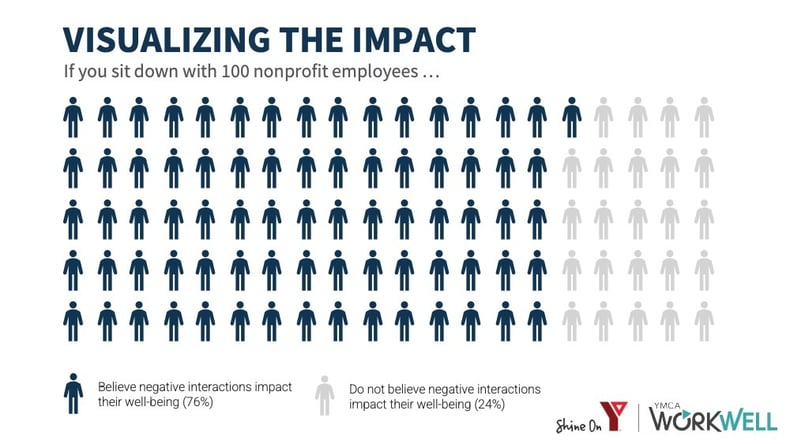
These interactions range in severity and tone – some are overt and hostile, some are passive and persistent, some are broadly directed at the organization, and others are far more personal. They can include hostile and abusive language, passive-aggressive behaviours, manipulation tactics, and physical abuse. We’ve heard about it all in our data.
And while much has been written about traditional nonprofit challenges like funding instability and overwhelming workloads, these increasing negative interactions present a significant burden that doesn’t receive enough attention – often being brushed aside as “part of the job”.
They will wear on anyone over time. So, when respondents say that these interactions “impact their personal well-being at work”, what does that really look like?
Why this matters: The emotional toll
These negative interactions are more than uncomfortable—they’re correlated with real workplace consequences:
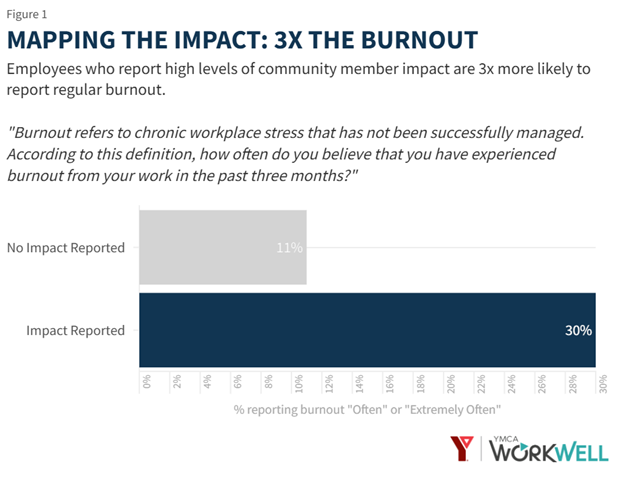
For example, employees reporting that these interactions impact their personal well-being are 3x more likely to report burnout “often” or “extremely often”:
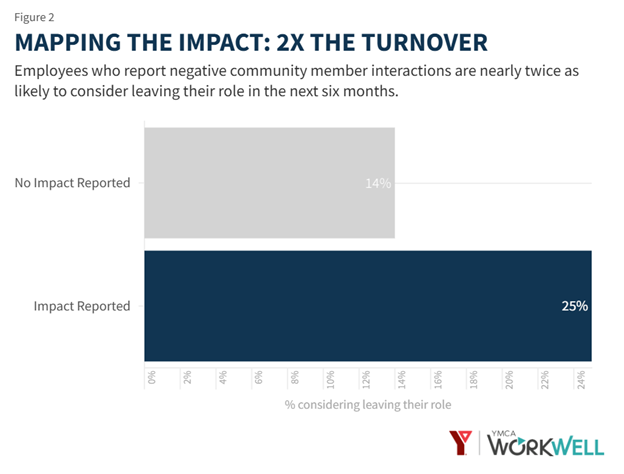
They are nearly twice as likely to consider leaving their role in the next six months:
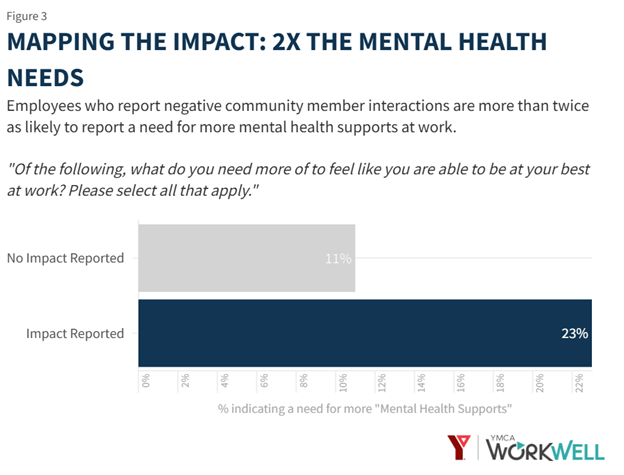
And they are twice as likely to report a need for more mental health supports at work:
Now, we take data seriously at YMCA WorkWell.
We know that correlation does not necessarily mean causation – but when 76% of nonprofit employees who report these negative interactions are impacting their personal well-being also report higher levels of burnout, higher turnover intentions, and a greater need for mental health supports…
We need to pay attention.
Bottom line: We need to take this seriously
Our organizations are powered by people who care – deeply. These are people who have often made personal and financial sacrifices to support their communities.
But when we brush negative interactions off as “part of the job,” we put our greatest asset – our people – at risk. This isn’t just about personal well-being; it’s about our collective ability to retain talent, deliver impact, and build sustainable communities.
The alarm is being sounded, and it’s time to take it seriously.
What’s next
This is just the first blog in a three-part series. In the next blog, we’ll focus on how front-line leaders are bearing the heaviest burden in these interactions – and what that means for organizational health.
Until then, let this be your call to pause and take these signals seriously. Because when connections weaken and our nonprofits suffer, our communities lose.
Author: Dave Whiteside
As the Director of Insights at YMCA WorkWell and with a Ph.D in Organizational Behaviour, Dave is all about telling powerful stories with data to help create healthier workplaces and healthier communities. Through our WorkWell Insights Surveys and our annual Workplace Well-Being Report, he provides leaders with actionable insights about their organizations, teams, and communities to be able to have the greatest impact in building healthier cultures.
The views expressed in this article are the author’s alone and do not necessarily represent those of CharityVillage.com or any other individual or entity with whom the authors or website may be affiliated. CharityVillage.com is not liable for any content that may be considered offensive, inappropriate, defamatory, or inaccurate or in breach of third-party rights of privacy, copyright, or trademark.
