
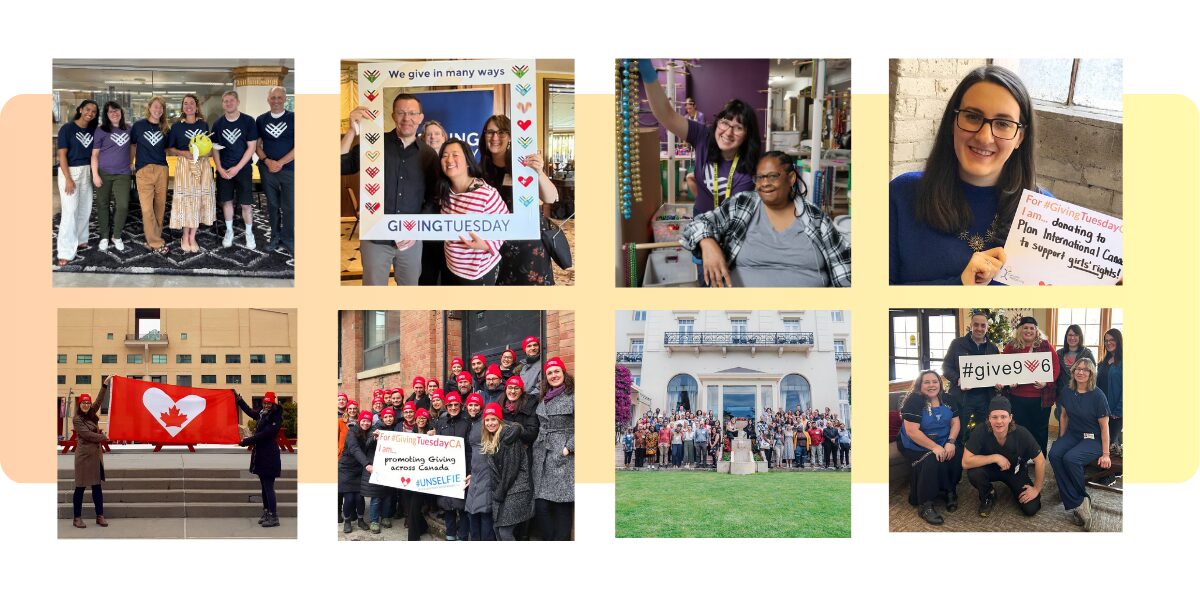

This year, GivingTuesday falls on December 2nd, 2025. As of writing this, that’s less than 40 days away! But it’s not just about the one day, it also marks the kick off of your Giving Season – usually the most critical time of the year for charities, when up to a third of donations come in.
To support your charity to have its most successful GivingTuesday and Giving Season yet, read on to get the facts on why you should participate, inspiration from campaign case studies and simple practical tips to getting started. (This blog has been adapted from the webinar “Ditch the Last-Minute Panic and Rock GivingTuesday instead” by Nicole Danesi and Victoria Leonhardt)
If you’d like to get more tips, templates and inspiration for year-end, all housed in one place, check out CanadaHelps’ new Giving Season Resource Hub.

Why should charities get involved in GivingTuesday?
Charities participating in Giving Tuesday on CanadaHelps have grown from 28% in 2018 to 42% in 2024. However, there is still a significant proportion of charities that are unconvinced about the value of participation. We wanted to explore some of the benefits of participation and bust one big myth about GivingTuesday.
- GivingTuesday doesn’t just mean “earlier donations of money we would have seen on December 31st”. Our research shows that many of the donations on GivingTuesday are net new donations – above and beyond what would have come in on Dec 31st.
- Overall, giving is trending downwards (you can read more about it in our Giving Report); we need to build a pipeline of sustainable giving in younger generations to reverse this trend. GivingTuesday is one way to do this, as our research shows that GivingTuesday appeals to younger supporters who are looking to be part of a bigger movement.
- GivingTuesday represents roughly 5% of annual giving on CanadaHelps each year and surpassed December 31st in terms of giving last year.
- Charities that participate in GivingTuesday, based on our data and insights, generate 2x more revenue in the period between GivingTuesday to December 31st.
- GivingTuesday isn’t just about fundraising, it’s about generosity; people participate in all different ways of giving – giving money, items and time. 36% of Canadians gave all 3 last year. Your volunteers are also the ones who might support your charity financially or vice versa, so you can think about a holistic approach to GivingTuesday that asks people to get engaged rather than just donate.
How are charities leveraging GivingTuesday?
So how do you participate yet stand out from the crowd? Charities have let us know that getting started can be overwhelming and that they don’t have the resources for elaborate campaigns.
Here are some creative ways charities have leveraged the GivingTuesday movement, from a small, specific community campaign, to a campaign that activated their volunteer network, and a media campaign that tapped into GivingTuesday excitement but went beyond the specific day.

Partridge Creek Farm (Michigan): Used a tiered donation goal with specific milestones and pivoted to a donor match mid-campaign, greatly exceeding their target. For their first-ever GivingTuesday, they set a goal to raise $5000 to purchase land. They also outlined tiered goals, such as $6500 that would allow them to do maintenance, $8000 to install a new fence, and $10,000 to enable them to buy tools for garden members.
Unexpectedly, a long-time donor offered to provide $5000 for matching gifts, so they jumped on this opportunity, adapting mid-campaign, to advertise this match. Another supporter followed their campaign closely and made an extra donation around midnight on GivingTuesday to ensure they hit their highest tier goal.
This is a fantastic example of how running a specific campaign can help you reach your GivingTuesday goals, no matter the size of your organization. Ultimately, Partridge Creek Farm managed to fundraise $10,850, enabling them to reach all of their targets and empower their urban farm community.
Lasagna Love: Lasagna Love mobilized a network of volunteer chefs to make and deliver lasagna to those in need. They created mini fundraisers, meal drives, and other creative acts of generosity. A major part of this was the social media aspect, where they gave a platform to volunteer chefs to go live on their own Instagram and share what it was like to build the lasagna and be involved. All of this helped to build excitement around a simple act of generosity and is a great example of a campaign that would work well for charities with a large volunteer base.
This campaign pulled together different ways of participating in generosity; it had the mini fundraiser element, used volunteers as ambassadors, developed meal drives, and is a really creative way to think about how we can be in community and use those networks to spread awareness, excitement, and engagement around what we’re doing.
Search for Common Ground – “The Things We Carry”: The global organization Search for Common Ground created a campaign called “The Things We Carry”, tying together storytelling, community gathering and digital activism.
The campaign engaged both donors and non-donors, integrating GivingTuesday into a broader end-of-year campaign. In terms of fundraising, this campaign raised $904,000 from 158 new donors. Engagement metrics include just over a million impressions with about 10,000 engagement points and video views across their social platforms.
The success of this campaign shows the power of GivingTuesday to go beyond a single day.
Practical tips for your GivingTuesday campaign
- Set clear goals. As in the Partridge Creek Farm example, those goals made it clear what the aim was, helped the charity to measure the success of their campaign and motivated their supporters with tangible outcomes.
- Develop a campaign that goes beyond the 24-hour period. Make it a year-round message and use GivingTuesday as a moment to amplify and celebrate generosity.
- Messaging should be human, actionable, and community-focused. Understanding where communities “hang out” (online or offline) is crucial to align outreach effectively.
- Offer multiple ways for supporters to give. Campaigns can include fundraising, volunteerism, item donations, and acts of kindness to provide various on-ramps for generosity.
- Leverage volunteers and ambassadors. Train select volunteers, board members, or influencers to represent and promote the campaign within their networks, enhancing reach and engagement. Amplify their stories both locally and digitally to create new, engaging content.
- Secure matching gifts. Matches may come from corporate partners, major donors, or board members. Matches motivate donors and boost fundraising. Some of our charity partners have seen success even with modest match amounts ($1,000 to $10,000).
- Re-engage previous major donors early. Reach out to your previous donors well before GivingTuesday – this could be a potential source for your matching gifts.
- Encourage feedback and community support during your campaign. Engaged donors want to help beyond giving money, offering perspectives and talents to overcome organizational hurdles.
Cindy Lee is a Digital Marketing Manager at CanadaHelps, supporting charities with resources and education to succeed in a digital world. CanadaHelps is Canada’s largest online giving platform. Since 2000, CanadaHelps has been used by over 5 million Canadians to give over $3 billion.
The views expressed in this article are the author’s alone and do not necessarily represent those of CharityVillage.com or any other individual or entity with whom the authors or website may be affiliated. CharityVillage.com is not liable for any content that may be considered offensive, inappropriate, defamatory, or inaccurate or in breach of third-party rights of privacy, copyright, or trademark.
