


It is well-documented that nonprofit organizations face a significant leadership transition over the next four years (Capacity Canada, CharityVillage, Imagine Canada). Retirements, burnout, and sheer demographics all point to the risks of failing to develop, support, and even find the next generation of leaders to run the approximately 85,000 nonprofit Canadian agencies (CRA). While larger nonprofit organizations appear to be better prepared for this reality (Carleton University), the succession planning crisis persists as demand for services continues to grow alongside the increasing challenge of attracting, and retaining available talent.
The Performance Pendulum™ – a leadership framework for the nonprofit sector
When considering the work, the context, and most importantly, the clients of nonprofit agencies, the leadership stakes are extraordinarily high. At Lake and Associates, we have worked with a range of Canadian nonprofit organizations over a number of years, and during this time, it became evident that leadership as a practice within the sector has been underserved by traditional leadership models. Recognizing the risk this presents to current and future success, we embarked upon a dedicated research project to address the shortfall. As a result, we developed the Performance Pendulum™, an original, evidence-based leadership framework shaped by, and for, nonprofit leaders. The framework is built around eight key leadership requirements, namely, Advocate, Adhere, Drive, Defer, Human, Hardened, Planetary, and Parochial.
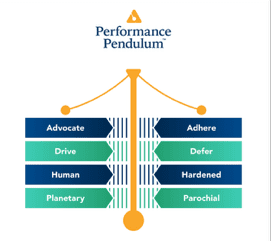
Advocate – Adhere
The ability to effectively Advocate is seen as a key leadership skill and core requirement in the nonprofit sector. This includes telling the story of the agency and the client, securing funding from government and private donors, and leveraging data to support the agency’s position. The influencing skills needed to Advocate – such as lobbying governments and attracting the attention of donors, funders, volunteers, and prospective employees – must be balanced with the compliance skills required for adherence. More specifically, leaders Adhere by responding to policy changes within, and because of, election cycles. Additionally, the ability to Adhere to increasingly high levels of detailed reporting and transparency factors into the perceptions of leadership success.
Drive-Defer
At a fundamental level, Drive and Defer depict a self-starting entrepreneur who, while independent and autonomous, nonetheless reports to a Board of Directors with clear governance guidelines and performance expectations. In Drive mode, the leader is an entrepreneur running the agency as a business, visioning and creating opportunities through innovations in programming and delivery. As an entrepreneur, the leader is engaged in creative problem-solving to increase funding or maintain services with funding restrictions, while navigating persistent financial instability. As an entrepreneurial leader, the CEO or Executive Director is outward-facing, building connections within the community and across all levels of government. To be viewed as high-performing, the leader must also Defer to the volunteer Board, funders, governments, and a public who may or may not be well informed regarding the complexities of the agency.
Human-Hardened
Within the values-based cultural context, the leader is expected to be both Human and Hardened. Human-centric leadership requires a demonstration of compassion for the cause, for the clients, and the staff. Leadership within social-profit organizations demands a strong belief in, and an emotional connection to, the work. Without a visible display of care, it could be challenging to be viewed as successful, yet caring alone is insufficient, as social-profit leaders are business leaders required to operate efficient organizations and make tough decisions. While all business leaders must make difficult financial and/or operational decisions, for social-profit leaders, fulfilling the demands of the Hardened leader may create moral distress if the consequences of their decisions negatively impact vulnerable clients in the short term. Stewardship and accountability for one may be in direct competition with stewardship and responsibility for the other.
Planetary – Parochial
Finally, the social-profit /nonprofit leader, regardless of geographic location or agency size, operates at a national and global level given the universal nature of client needs. This Planetary perspective means the leader and the agency are part of a larger social network and challenge. Such global influences and awareness are in play for the organization, bringing potentially large-scale expectations for resolution. Furthermore, as the global influences are seen at the local level, the leader must remain closely connected with the immediate community, build strong relationships, and demonstrate a measurable impact within their own jurisdiction. The leaders then find themselves competing locally for resources, funding, donors, volunteers, and staff, creating a Parochial element to their leadership practices as they work to achieve the agency’s strategic and operational goals.
Sector-specific leadership development for Executive Directors / CEOs and high-potential leaders
Introducing a targeted leadership development solution designed to address the needs of the nonprofit leader. Utilizing the Performance Pendulum™ framework, this program delivers sector-specific insights, actionable tools, opportunities for individual prioritization, and group discussion. The program, led by professional facilitators from the Lake and Associates research team, is delivered online, in real-time, over a period of eight weeks. Enrolment is now open for the winter program, which runs from February 18 – April 8, 2026; and for the spring session May 6 – June 24, 2026. Email Rashmi Biswas at rashmi@performancependulum.com to reserve your spot.
Further applications of the Performance Pendulum™ include working with Board Members, Staff, HR leaders, and independent consultants, as follows:
- Board Presentations – introducing the framework to board members to strengthen their understanding of the demands of leadership at the ED / CEO level.
- Facilitated workshops to incorporate the framework into Strategic Planning, Board Retreats, and Staff workshops.
- 360 Assessment tool – based on the competencies and behaviours inside the framework, this can be delivered as a follow-up to the Leadership Development program, or independently as part of an Executive Coaching engagement.
- Supporting professional coaches in bringing the 360 Assessment tool to their clients.
The succession planning crisis is real, the time to take action is now, and the sector deserves a focused solution. For more information and to download the white paper, The Neglected Sector: Leadership Development in Social-Profit Organizations, visit Performance Pendulum™.
Rashmi Biswas is a leadership strategist, workplace learning expert, and skilled facilitator with a career spanning Canada, the U.S., and the U.K. With a Master’s degree in Human Resource Management, a Postgraduate Certificate in Adult Education, Facilitation and Training, Rashmi bridges theory and practice sharing over two decades of cross-sector insights with Clients in her role with Lake and Associates. Rashmi works with senior leaders across public, and private sector organizations, in non-profit, complex, mission-driven environments, and has provided consulting services across Canada, in South America, Asia, and the Middle East. Rashmi is a program facilitator with OISE at the University of Toronto, and currently serves as Vice-Chair of the Board of Governors for Niagara College.
The views expressed in this article are the author’s alone and do not necessarily represent those of CharityVillage.com or any other individual or entity with whom the authors or website may be affiliated. CharityVillage.com is not liable for any content that may be considered offensive, inappropriate, defamatory, or inaccurate or in breach of third-party rights of privacy, copyright, or trademark.
