


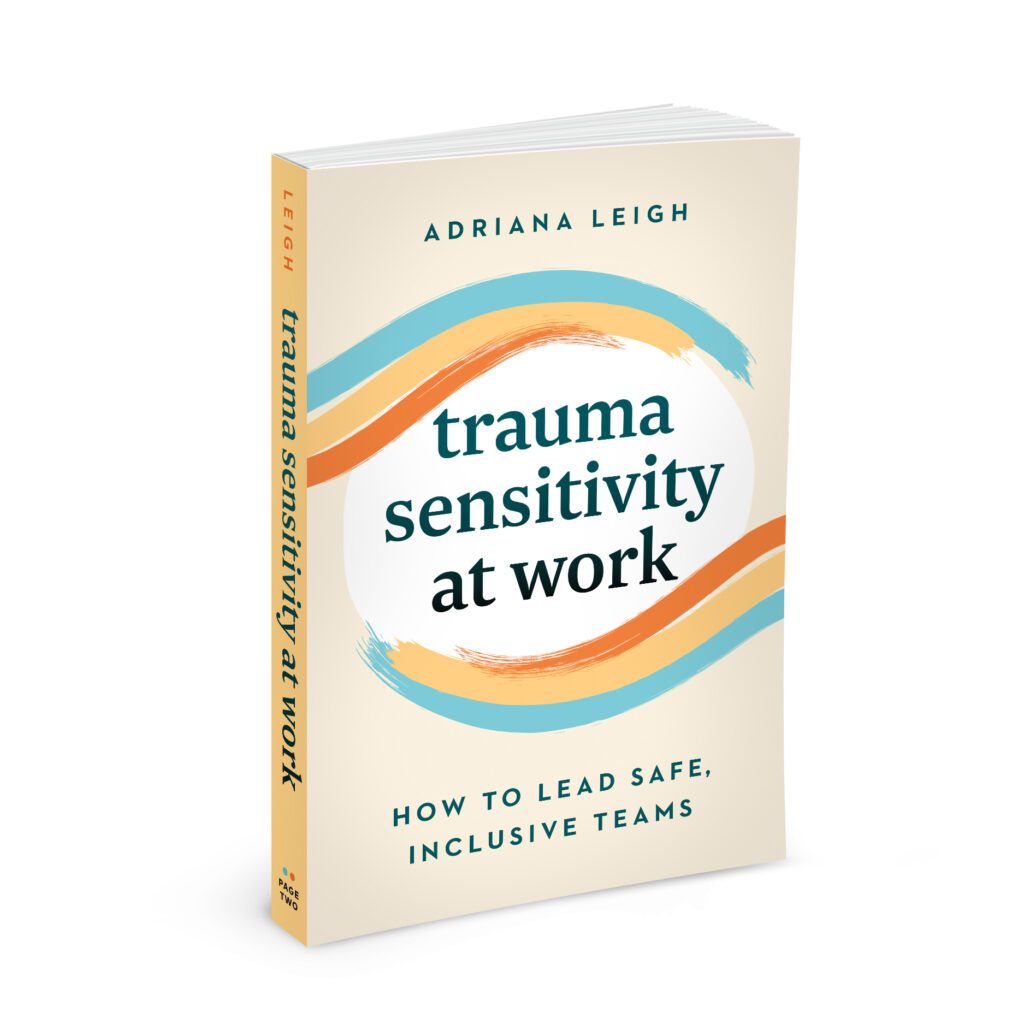
This article is an excerpt* of Adriana Leigh’s new book, Trauma Sensitivity At Work: How to Lead Safe, Inclusive Teams, published by Page Two Books.
Now that you know more about trauma-informed principles generally, let’s explore how you can use them to guide improvements in your team culture to prevent burnout and turnover and to manage conflict. Below are the seven key culture-change strategies you need to be trauma sensitive:
- Slow down
- Check in
- Develop behavioural guidelines
- Collaborate on workload management
- Show gratitude
- Support peers
- Raise trauma awareness
For this excerpt article, let’s unpack the check in.
Check in
Leaders ultimately need to make it safer for team members to express their feelings, or build what I call “emotional safety,” so that they come to a leader before a situation escalates. The term “emotional safety” is connected to “psychological safety,” codified by Amy Edmondson. Psychological safety refers broadly to the belief that one will not be punished or humiliated for speaking up with ideas, questions, concerns, or mistakes. It allows interpersonal risk-taking. I prefer the term “emotional safety,” as it emphasizes that we need to make it safe for people to feel and express their feelings at work.
A skilled leader needs to create the conditions where folks can surface their feelings and know they will be supported. If you are a team leader, one tool you need to master is the art of checking in.
Check-ins are more than asking people, “How are you?” They are an opportunity for an intentional slowdown, to take stock. They don’t have to be overly detailed, and you can build them into team meetings with creative and visual strategies that create safety for people to name their experience more concretely. One easy, quick check-in on energy levels, called 1–5, allows folks to articulate their energy levels from one to five. After this check-in, you can adjust the meeting to people’s energy levels and respond in a way that is attuned to how the team is feeling.
Another creative check-in one of my teams liked was asking, “What colour are you today?” This was a way to normalize speaking about feelings. When my team did this, I saw people light up who would otherwise appear quite stoic.
They revealed sides of their personality I had not seen previously. These little moments help people feel safe to bring more of themselves to work.
You can also hold regular, more extensive check-ins to discuss challenging events at work. When doing so, remember to make check-ins consensual, and don’t require folks to relive a traumatic moment by resharing it with a group. The point of check-ins should be to create safety for folks to share if they choose to do so. Patricia Fisher and TEND Academy provide useful guidance on team check-ins that engage the concept of low-impact debriefing (LID). LID is a four-pronged “technique for sharing and processing the difficult stories and images that we encounter in our work.” It includes four steps:
- Self-awareness: Be aware of the level of detail you offer. It is not necessary to share all the details of a difficult situation at work. Sharing all the details can either retraumatize or vicariously traumatize people, leading to distress.
- Fair warning: Give the listener a heads-up that what you are going to share might be disturbing.
- Consent: Seek permission to share. You can ask the listener if it’s a good time to talk and warn them that the content may be difficult.
- Limited disclosure: Start at the outside of the story, with the least difficult content, adding information only if necessary.
Beyond team check-ins, carving out regular one-on-one time with each team member is good practice in general and essential if you work in an environment at high risk of vicarious trauma. Do this at regular intervals in each of your team members’ work life cycle (for example, at orientation, at a minimum of three months into the job, and at least a couple more times a year).
Samantha Fernandes and Christopher Eastmond lay out a leadership competency framework to help spot early signs of burnout in staff working in primary care settings. The model highlights how leaders can more proactively prevent burnout through empathetic and efficient check-ins. Although the framework was created for the health care setting, it can guide all leaders on questions to ask during individual check-ins with team members to prevent burnout. For example, during onboarding, leaders can set the stage by asking, “Is there anything you need from me as a supervisor to help you perform your day-to-day duties, and what kind of support do you most need from me?” Leaders can then check in three months after onboarding about whether anything in the workplace makes the team member feel unsafe, and what could help them feel safer.
If you are a team leader, be mindful not to move too quickly to “fix it” or get into “solutions mode” during check-ins. That can be a way of bypassing the feelings of team members. In addition, sending agenda items before meetings, including check-ins, so that folks know what to expect, is good practice; this way, team members can prepare and feel less anxious coming into meetings.
Adriana Leigh is an award-winning international consultant and changemaker, and the founder and principal consultant at ALG Consulting. She is author of Trauma Sensitivity at Work: How to Build Safe, Inclusive Teams (April 2026, Page Two Books).
With over twenty years of global experience, she is a former workplace human rights lawyer turned facilitator, working at the intersection of DEI, gender-based violence and harassment prevention, and psychologically safe workplace systems.
*The excerpt is reproduced with permission from the author. All rights to the content remain with the author. Unauthorized reproduction or distribution beyond the agreed scope is not permitted.
The views expressed in this article are the author’s alone and do not necessarily represent those of CharityVillage.com or any other individual or entity with whom the authors or website may be affiliated. CharityVillage.com is not liable for any content that may be considered offensive, inappropriate, defamatory, or inaccurate or in breach of third-party rights of privacy, copyright, or trademark.
