


When we experience conflict, we are most likely to look at the situation to determine who was at fault. This is a natural human reaction in the experience of conflict. Often, emotions are running high, adrenaline is activated, and our nervous system is alert. However, taking a moment to look at what might be happening behind the scenes of the experience will always contribute to gaining a wider perspective – and possibly even lead to greater understanding, compassion, and learning. At the very least, you will have a calmer approach to resolving the conflict.
When conflict arises in business, it can take on a different tone than when we have disagreements with friends and family in our personal lives. We tend to have a greater willingness to be more open, vulnerable, and emotional with people we know well. In a business setting, we may hesitate to express ourselves, question others, appear vulnerable or ask for what we need. The fear of damaging our credibility or reputation if we address conflict is a key reason team members avoid stepping into conflict with colleagues, customers, suppliers, and other business stakeholders.
The conflict source triangle is a simple tool that you can use to help untangle a difficult situation by shifting the focus from who caused the problem to what is at the source of it. No matter who has the highest degree of fault in causing the conflict, the source of any discord stems from one or more of these three pivotal elements: thoughts, actions, and words. It sounds quite simple. And it is.
However, in moments of high emotion when our bodies and minds are flooded with emotions, what can be difficult is to simply make the choice to pause and consider the source of the conflict.
Our communication style is comprised of many habits, and the average person has little awareness of their own communication habits. We have habitual ways of greeting people. We have habitual ways of saying no. We also have habitual ways of addressing or avoiding conflict when it arises in our daily lives. I invite you to consider using the conflict source triangle tool to grow your personal awareness to help you form new habits for dealing with conflict when it arises.
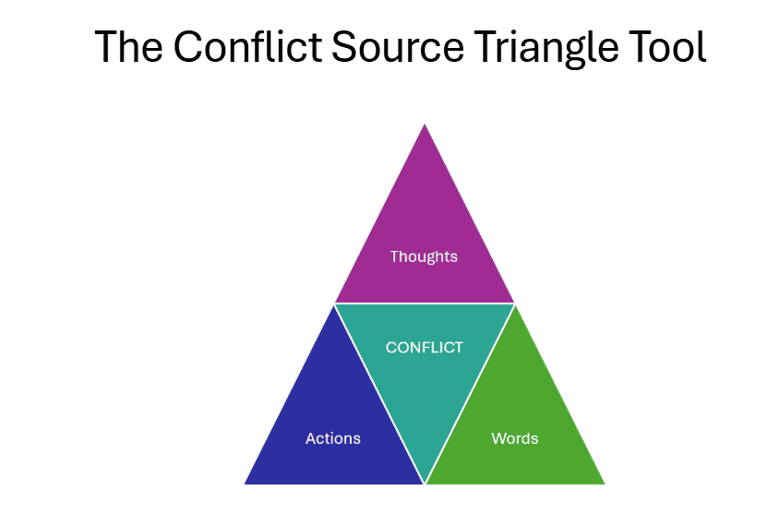
Consider a recent conflict that occurred in your workplace and is still lingering unresolved. When you recall that experience, can you spot the source of the disagreement?
Thoughts: Was there an error in thinking that caused or contributed to the conflict? What part did assumptions play in creating additional conflict or confusion? What facts, understanding, or perceptions need to be clarified in order to resolve the issue?
Actions: Were you upset by something that occurred? What action, activity or behaviour was at the source of the disagreement? What action would now help to resolve the conflict?
Words: What was said that was the source of the conflict? What words were used that contributed to the conflict? Was there an omission of information or facts? What could have been said instead to minimize or eliminate the conflict? What still needs to be said to resolve the issue?
Now what?
Once you’ve determined the source of the conflict, it is imperative that you go back to the source to seek the solution to resolve it. Conflict that resides in actions can be solved by acknowledging and resetting the situation with the right action. The same is true for words and thoughts. Without doing this work to reflect on the source of the conflict, we usually attempt to solve an issue of words by “making it right” with actions. Or we refrain from admitting our assumptions and attempt to speak our way out of a conflict situation. Simply, the solution is at the source.
The conflict source triangle is a valuable reflection tool for understanding what is behind the scenes of the discord. Quite deliberately, the tool begins with the element of “thoughts”. In our interactions with others in daily life, any communication of words or actions begins first as a thought. Therefore, it is important to consider the thinking that rests behind the conflict as the starting point for understanding what went wrong. However, the tool is effective no matter which element you begin with for your reflection on the source of the conflict.
When you use the tool over time, it can help you anticipate conflicts before they even arise. You can sense that a thought, action, or word holds the potential for confusion, chaos, and conflict. It becomes easier to spot the potential source of an issue and correct it by resetting the thought, action, or words before things get out of hand and negatively affect your workplace relationships.
Sonia Byrne, CHRL, is an organizational consultant whose work focuses on building sustainable leadership practices and teambuilding experiences to support organizational stability in times of change, chaos, and uncertainty. Sonia has been providing leadership consulting, team retreat experiences, and conference workshops in the nonprofit sector since 2009. Connect with her today at Sonia Byrne – Mindful Leadership for Success.
The views expressed in this article are the author’s alone and do not necessarily represent those of CharityVillage.com or any other individual or entity with whom the authors or website may be affiliated. CharityVillage.com is not liable for any content that may be considered offensive, inappropriate, defamatory, or inaccurate or in breach of third-party rights of privacy, copyright, or trademark.
