


The charitable sector in Canada is facing a severe recruitment and retention crisis, threatening its ability to deliver essential goods and services. In 2020, Statistics Canada reported that 38% of nonprofits anticipated challenges in recruiting skilled employees, while 33% expected difficulties in retaining staff. A study by the Ontario Nonprofit Network in 2022 revealed that 65% of nonprofits were struggling with these HR issues, with Indigenous- and Black-led organizations facing particularly dire conditions.
Although the COVID-19 pandemic intensified these challenges, the root cause remains the sector’s chronic underfunding. A study from the Munk School of Global Affairs and Public Policy highlighted how insecure funding has led to low wages, unstable employment, and high turnover for decades. As a result, burnout, declining morale, and difficulty attracting and retaining talent have become widespread.
What CICP data reveals about employee turnover
Since 2022, the Charity Insights Canada Project (CICP) has surveyed charities weekly to track sector-wide challenges. In early 2024, we specifically examined staff retention, uncovering a significant increase in employee turnover—primarily driven by insufficient pay, benefits, and rising burnout.
Employee turnover trends:
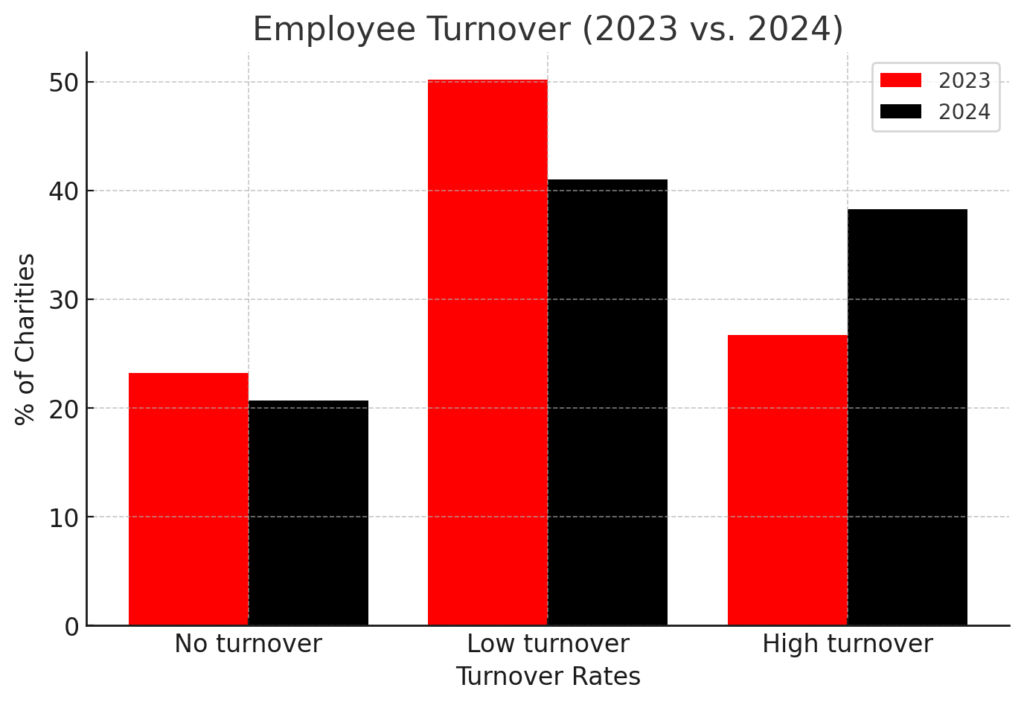
We categorized turnover into three groups:
- No turnover
- Low turnover (1-20%)
- High turnover (21-100%)
Our data shows a worsening trend over time. Organizations reporting no or low turnover decreased between 2023 and 2024, while high turnover jumped from 27% to 39%.
Turnover by organization size
Larger organizations historically experienced higher turnover, but by 2024, even smaller charities were significantly affected. For instance:
- In 2023, organizations with annual expenditures over $61,529 reported higher levels of turnover.
- By 2024, charities with expenditures under $61,529 also faced more significant staff departures.
This shift indicates that staffing instability is increasing across the sector, regardless of a charity’s size.
| No Turnover | Low Turnover | High Turnover | ||||
| Annual Expenditures | 2023 | 2024 | 2023 | 2024 | 2023 | 2024 |
| $1-11661 | 69%* | 50%* | 15.5%* | 33%* | 15.5%* | 17%* |
| $11662-61529 | 69%* | 40%* | 19%* | 11%* | 12%* | 49%* |
| $61530-229133 | 44% | 35.5% | 32% | 29.5% | 24% | 35% |
| $229134-791421 | 24% | 20.5% | 47% | 40.5% | 29% | 39% |
| $791422+ | 11% | 5% | 62% | 57% | 27% | 38% |
Turnover by years of operation
While newer charities (1-15 years old) reported lower turnover in 2023, that advantage disappeared by 2024. High turnover rates are now affecting both younger and well-established organizations alike.
| No Turnover | Low Turnover | High Turnover | ||||
| Years of Operation | 2023 | 2024 | 2023 | 2024 | 2023 | 2024 |
| 1-15 years | 40.5% | 24% | 29% | 37.5% | 30.5% | 38.5% |
| 16-24 years | 18% | 22.5% | 60.5% | 41.5% | 21.5% | 36% |
| 25-32 years | 24% | 18.5% | 52% | 42.5% | 24% | 39% |
| 33-41 years | 19% | 16% | 49% | 44.5% | 32% | 39.5% |
| 42+ years | 23% | 23% | 53.5% | 38.5% | 23.5% | 38.5% |
Urban vs. rural turnover rates
In 2023, rural charities—measured using the RST (Rural and Small-Town) metric—had lower high-turnover rates (20%) compared to urban organizations (28%). By 2024, that gap vanished as well, with both urban and rural charities reporting 38.5% high turnover. This suggests that HR challenges are now widespread, regardless of location.
Why are charity employees leaving?
To understand the root causes of turnover, we analyzed data from organizations that reported staffing losses. The primary reason behind employee turnover in the charitable sector remains remuneration and benefits, with a staggering 45% of charities citing this as a critical factor in 2023 and 47% in 2024. Additionally, burnout and being overwhelmed by workload pressures are growing concerns, increasing from roughly 28% in 2023 to roughly 35% in 2024. The combination of better opportunities elsewhere, retirement, and staff leaving the sector altogether further exacerbates this critical HR challenge (see table below).
| Reasons for Employee Turnover | 2023 | 2024 |
|---|---|---|
| Renumeration and benefits | 45% | 47% |
| Overall better opportunities elsewhere | 35% | N/A |
| Overwhelmed by the amount of work/burnout | 28% | 35% |
| Leaving the sector | 24% | 23% |
| Retirement | N/A | 19% |
How can the sector address the HR crisis?
The ongoing data collection by the CICP continues to highlight the urgency of addressing the HR crisis in Canada’s charitable sector. Precarious funding, heavy workloads, and insufficient pay are driving skilled workers out of the sector, while organizations are left grappling with mounting service demands. To sustain charities to achieve their missions and serve communities effectively, we must advocate for more secure funding and sector-wide strategies to support the charitable workforce.
Dr. Tara McWhinney is a feminist political economist with expertise in social policy analysis and cartographic research. McWhinney is a postdoctoral fellow with CICP.
Figures created with ChatGPT.
The views expressed in this article are the author’s alone and do not necessarily represent those of CharityVillage.com or any other individual or entity with whom the authors or website may be affiliated. CharityVillage.com is not liable for any content that may be considered offensive, inappropriate, defamatory, or inaccurate or in breach of third-party rights of privacy, copyright, or trademark.
