


In almost every webinar or talk I give, someone asks me the same question: how can a small, overstretched team keep up with donor stewardship? My answer is always to start with some basic automations to cover your bases. But I always add a caveat, and it’s an important one.
Automation is part of the strategy, but it’s not the strategy. It will never replace personalized, individualized stewardship. Relationships are built through real, authentic conversations. Small teams are stretched thin, and “we don’t have time” is a real constraint, not an excuse. But my point here isn’t to ask you to choose between automation and personal connection. It’s to make the most of the time you do have, and spend it where it counts.
Start with segmentation
You cannot give every donor the same amount of time, and unless you’re just starting out and have a very small list of donors, I don’t recommend it. The first step is figuring out who makes the most sense to focus on first.
My recommendation? Start with your monthly donors. They are your most loyal supporters and the ones most likely to increase their giving over time. They’re also the most likely to become legacy donors (I know, I was surprised too!) Then look at your major and mid-level donors.
Start by identifying the top thirty donors in your organization. These are the people who should hear from you individually, not just through a newsletter. Your goal should be to know three “personal” details about these donors: Do they have a dog? Do they have kids? What got them into supporting your work?
Your mid-level donors deserve at least one personal touchpoint a year, both to maintain the relationship and to help them grow into major donors over time.
Build a stewardship matrix
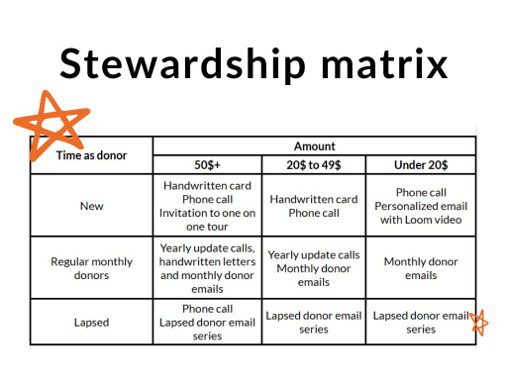
Once you know who your priority donors are, map out what stewardship actually looks like for each group. This is where a stewardship matrix comes in.
Your major donors might receive a personalized phone call, an email from your executive director or board president and a handwritten note in the mail. Depending on your capacity, you might invite them to a tour or a small event. Mid-level donors might receive a simpler version: a phone call and a personalized email. The point of the matrix isn’t to do everything for everyone. It’s to be intentional about what each relationship gets. Here’s a very basic example of a stewardship matrix for monthly donors that combines personal touchpoints and automations to illustrate what I mean:
The strategies that actually build connection
So what do these personal touchpoints look like in practice?
Pick up the phone. I know, people don’t answer calls the way they used to. But when you call a donor just to say thank you, with no ask attached, they notice. It opens the door to a real conversation, the kind you can’t have over email. If they don’t pick up, leave a voicemail. The gesture still goes a long way.
Send physical mail. It doesn’t need to be branded or fancy. Some of my favourite stewardship moments with clients have come from something as simple as a postcard, especially for donors who live outside the country. A little sticker, a handwritten line, a sense that a real person put this in the mail. That’s often all it takes.
Meet donors where they already are. If a donor is active on social media, send them a quick direct message thanking them for their engagement. If it’s a Friday, send a short note wishing them a good weekend and thanking them for their support. Even two or three lines can go a long way.
Offer a coffee chat. In a follow-up email, invite the donor to a short fifteen-minute call to talk about what motivates their support. Beyond strengthening the relationship, these conversations often surface stories you can use as testimonials down the road. Donors will feel so special that you want to meet them.
Why this matters
Every one of these touchpoints has the same underlying goal: making sure your donors don’t feel like an ATM machine. That’s an icky feeling that no one enjoys.
I think about one donor in particular, Brian. Through consistent personal touchpoints, phone calls, notes, and Facebook conversations, Brian went from a twenty-dollar-a-month donor to a monthly gift in the range of one hundred and seventy dollars. He later became a legacy donor, and today he actively brings in new monthly and individual donors on his own. All of this happened in less than two years. None of that happened because of a well-timed automated email. It happened because someone made him feel seen for who he was: a dog-loving photographer with a huge heart.
That’s really the whole point. You are a human being, and the people who support your mission want to talk to a human too. They don’t want a relationship with a newsletter, a brand, or a logo. They want to know there’s someone behind the work who cares about them, who understands the vision they’re helping build, and who wants to build it alongside them.
Automation can carry the administrative weight and cover your bases. But the relationship, the thing that turns a donor into a partner, still has to be human.
If you’re looking for a way to get started with donor stewardship, I invite you to check out my 30-day stewardship challenge: DonorLingo. It’s free, and it will give you ideas, templates, and the structure to get started.
Want expert support to build your monthly giving program? Book an exploration call with Katherine of Just Be Cause Consulting today.
The views expressed in this article are the author’s alone and do not necessarily represent those of CharityVillage.com or any other individual or entity with whom the authors or website may be affiliated. CharityVillage.com is not liable for any content that may be considered offensive, inappropriate, defamatory, or inaccurate or in breach of third-party rights of privacy, copyright, or trademark.
