

This article is part 1 in a two part series. Stay tuned for part 2!
We often think of the workday as a set period of time – we start work in the early morning, finish work in the late afternoon, and then turn off once we’re off the clock. But for so many people, the workday isn’t just 9 to 5.
The workday includes a parent’s medication schedule. A child’s school soccer game that starts at 4:30. A specialist appointment that could only be booked at 2pm on a Tuesday an hour away. A partner who needs help getting up the stairs. A late-night text from a sibling about Mom. And then, often, back to the laptop once the house is finally quiet.
In partnership with the Women’s Nonprofit Network, our team at YMCA WorkWell surveyed nearly 900 women and gender-diverse professionals across the nonprofit sector, and one statistic really jumped out at me: 61% of them are caregivers – people who provide direct care for someone who depends on them. That’s 3 in 5 raising young children, supporting aging parents, caring for a partner or adult child with a disability, or showing up for a family member or friend who depends on them.
What does that mean? Caregiving isn’t a niche issue affecting a handful of your people. For most of the people holding our sector together, it’s the norm.
And the data shows that caregiving itself isn’t the problem. The problem is what happens when caregiving has nowhere to go but into the workday, without a structure to catch it.
Let’s let the data do the talking.
Caregiving doesn’t stay at home
To understand the impact of caregiving, we asked hundreds of caregivers a simple question:
To what extent do your caregiving responsibilities affect your experience at work?
The answers were striking. Sixty-nine percent said caregiving has a clear effect on their work – and one in five (20%) said it affects their work significantly. Only 7% of caregivers said it had no effect at all.
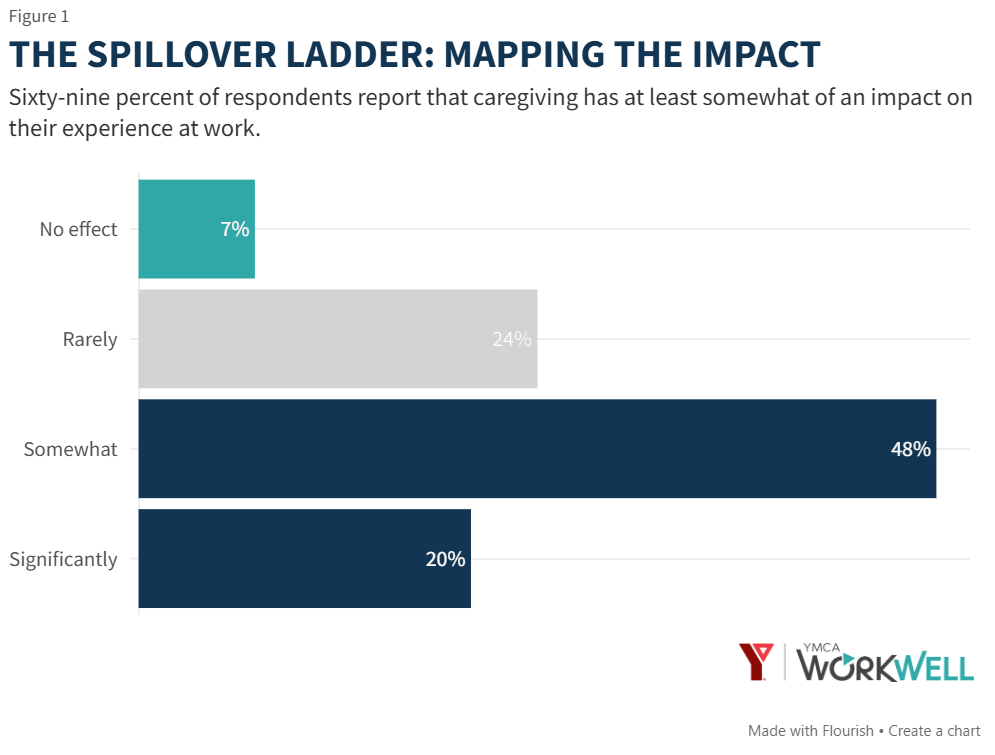
We call this the “spillover ladder” – the step-by-step ways that caregiving responsibilities can spill over into the workday. And it’s remarkable that far more often than not, caregiving has a real impact on someone’s work.
Sit with that for a second. We talk a lot about work-life balance in our sector and how our work life is creeping into our home life – but we don’t talk often enough about how we bring our home life into work too. For the majority of caregivers in our sector, a clear line between home and work simply does not exist. The mental load of coordinating care, the interrupted focus, ruminating on the challenge of the day, the appointments that don’t fit neatly into evenings and weekends – it travels with them into and throughout the workday whether we acknowledge it or not.
The question for leaders isn’t whether caregiving shows up at work – it will. It’s whether your organization is set up to absorb it – or whether your people are absorbing it alone.
The more it spills over, the more people burn out
Here’s where the story gets even clearer.
Caregiving responsibilities are having a clear impact on people’s experiences at work, but just how tangible is this impact on their well-being? To answer this question, we asked respondents:
Burnout refers to chronic workplace stress that has not been successfully managed. According to this definition, how often do you believe that you have experienced burnout from your work in the past three months?
When we compare the spillover ladder with how often people report burnout “Often” or “Extremely Often” at work, we see an undeniable and steady climb.
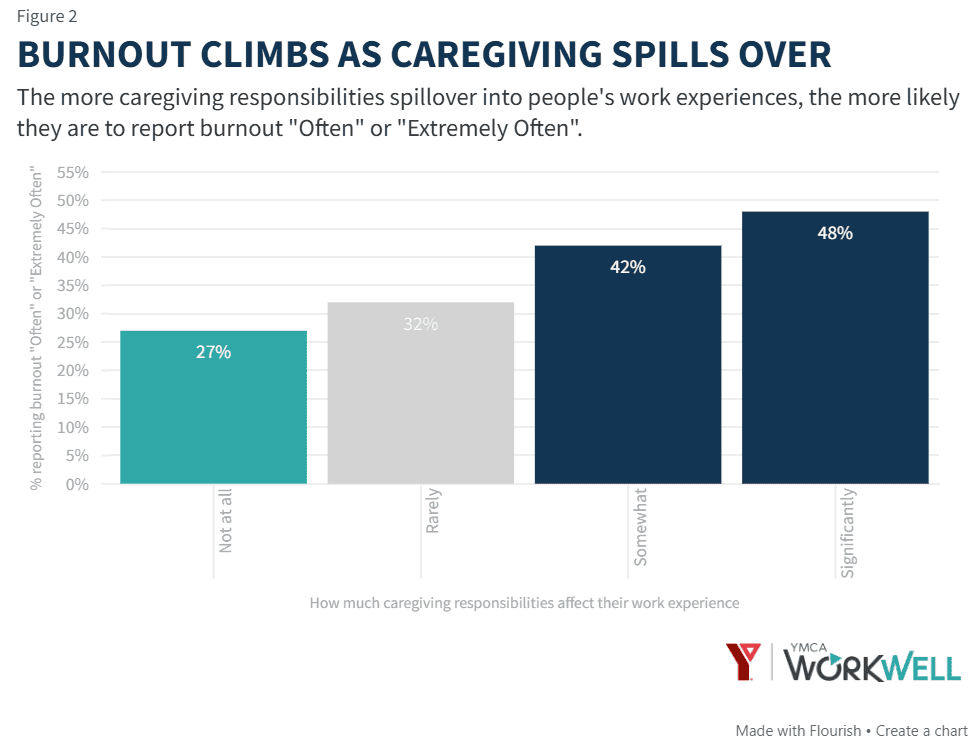
Every step up the spillover ladder, burnout climbs with it – and this is referring specifically to chronic stress at work. By the time caregiving is significantly affecting people’s work experiences, half are burning out regularly – 1 in 2 – compared to 27% of employees who do not feel affected by their caregiving responsibilities.
This isn’t just noise in the data. It tells a simple and statistically significant story: The more caregiving bleeds into work, the more likely someone is to be running on empty.
Digging into the details
There are so many forms of caregiving, all with their own challenges and responsibilities. Oftentimes, the most interesting takeaways are in the details – and we wanted to know how different types of caregiving showed up in the data.
To provide a clean comparison, we isolated three different groups:
- Employees caring only for young children at home.
- Employees caring only for an aging parent, a partner, or an adult child with a disability or chronic condition at home.
- The Sandwich Generation caring for both children and adult dependents.
The differences were telling.
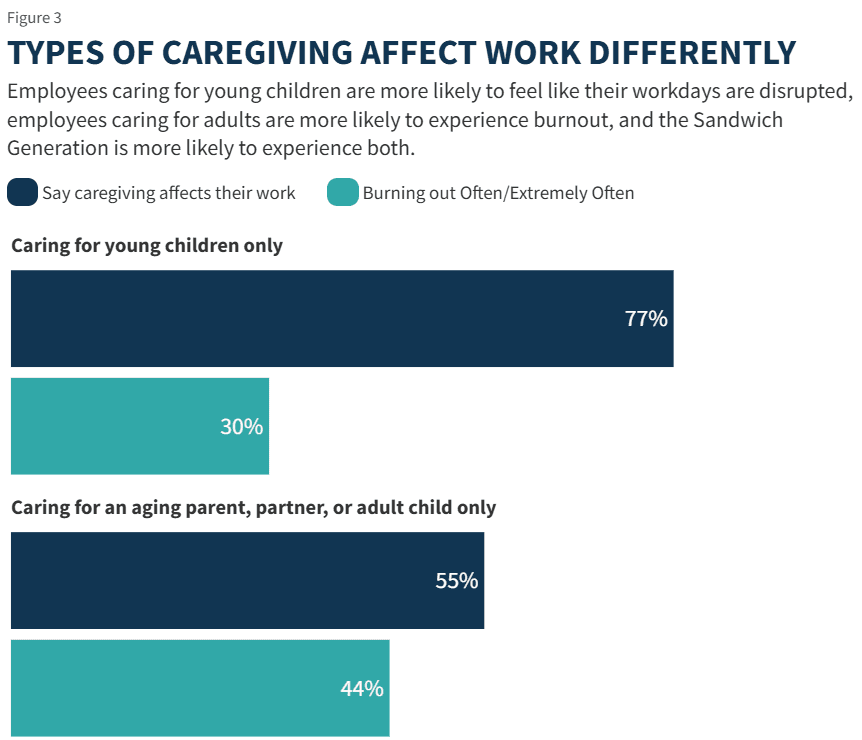
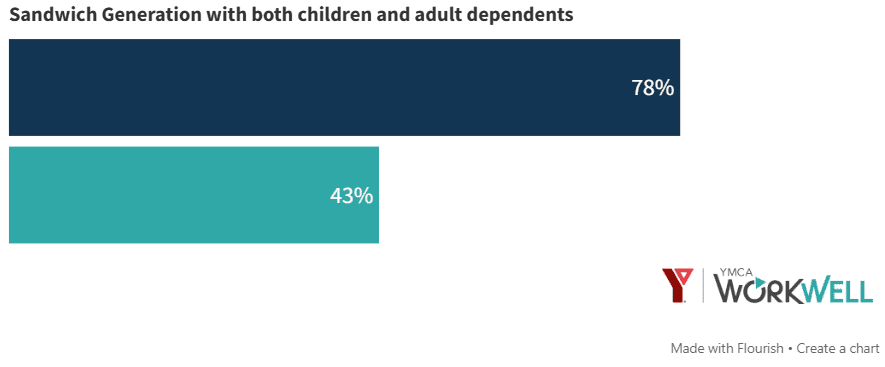
What is the story here? Stay tuned for part 2!
Learn more on our Insights Page or reach me directly at dave.whiteside@ymcathreerivers.org. We’d love to help.

The views expressed in this article are the author’s alone and do not necessarily represent those of CharityVillage.com or any other individual or entity with whom the authors or website may be affiliated. CharityVillage.com is not liable for any content that may be considered offensive, inappropriate, defamatory, or inaccurate or in breach of third-party rights of privacy, copyright, or trademark.
