


Includes a FREE, lawyer-vetted Employment Contract Template and other valuable resources!
Getting employment contracts right isn’t just a legal checkbox; it’s peace of mind for everyone in your nonprofit. If your organization still relies on handshake agreements or old offer letters, right now is the perfect time to upgrade. Let’s walk through what makes a nonprofit employment contract effective, why it matters, and how you can grab a free, lawyer-vetted template built for your needs.
We’ve done the hard work for you: Download your free contract template
Download our free, lawyer-made, employment contract template, designed for nonprofits in all provinces of Canada except Quebec. It’s comprehensive, legally sound, and tailored for the unique needs of nonprofit organizations across the country.
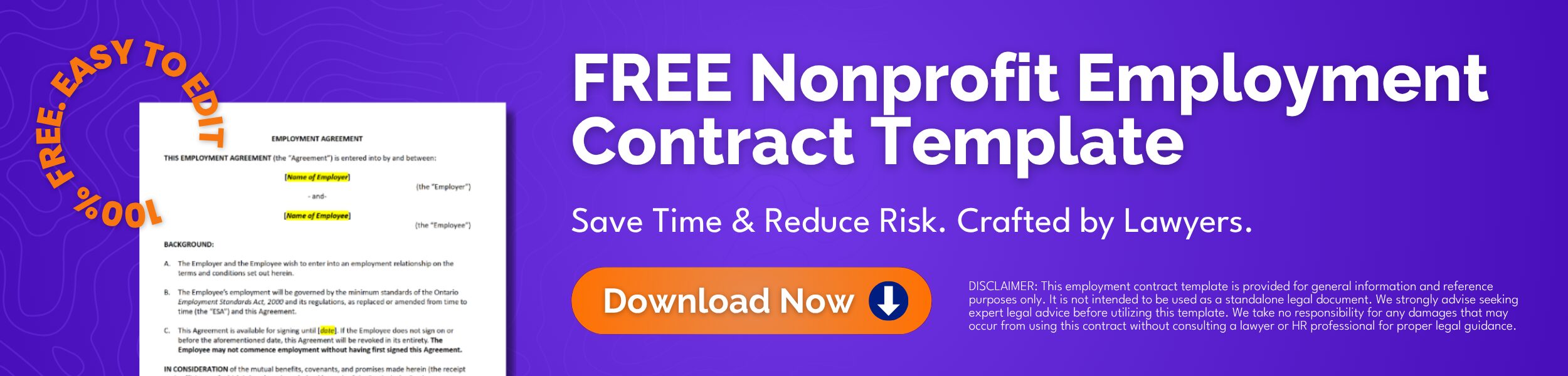
Click here to download your free employment contract template!
Disclaimer: This employment contract template is provided for general information and reference purposes only. It is not intended to be used as a standalone legal document. We strongly advise seeking expert legal advice before utilizing this template. We take no responsibility for any damages that may occur from using this contract without consulting a lawyer or HR professional for proper legal guidance.
Along with the employment contract template, we’re providing a suite of resources to make employment contracts easier for your nonprofit:
- Employment Contract Template
- Employment Agreement Checklist
- Employee vs. Independent Contractor Checklist
- Webinar recording: “Employment Contracts: What You Need to Know ” with Darcy Michaud, Chief Services Officer at HR Covered Inc.
- Webinar recording: “Why employment contracts are essential to your business” that features Anatoly Dvorkin, CEO and employment lawyer at HRC Law Professional Corporation, and Ljubica Durlovska, employment lawyer at HRC Law Professional Corporation.
Get all these resources in one easy download!
Why do nonprofits need an employment contract?
Employment contracts are a cornerstone of good HR management. Here’s why they’re especially important for nonprofits:
- Termination procedures
Terminations can be stressful, especially for key roles like Executive Director. A contract ensures advance notice of resignation, outlines termination procedures, and addresses severance—helping your organization avoid operational disruptions. - Clarity and consistency
Contracts establish clear expectations for both employees and the nonprofit, reducing misunderstandings and promoting consistent practices. - Legal protection
Contracts clearly define rights, responsibilities, and obligations, reducing the risk of disputes and providing a framework for conflict resolution. - Compliance with employment laws
Contracts help ensure adherence to federal and provincial employment legislation, including minimum wage, overtime, vacation entitlement, and other statutory standards. - Confidentiality & non-disclosure
Protect sensitive information, donor lists, and proprietary data with confidentiality clauses. - Intellectual property protection
Clarify ownership of intellectual property created during employment, ensuring your nonprofit retains the rights it needs. - Compensation & benefits
Clearly outline salary, bonuses, benefits, and other perks to avoid disputes. - Accountability & professionalism
Demonstrate your commitment to ethical employment practices, strengthening your reputation with staff and stakeholders. - Job security
Contracts provide employees with certainty regarding employment duration and termination provisions, enhancing trust and morale. - Recruitment & retention
A clear, professional contract helps attract and retain skilled, committed staff.
Pro tip: Employment laws vary across provinces. Always consult an expert familiar with nonprofit HR and employment law in your jurisdiction.
What key clauses should you include in your contract
A strong nonprofit employment contract should cover:
- General clauses: Confirmation of employment offer, background check requirements, and any conditions that must be met before employment begins.
- Employment details: Start date, probationary period, work location, reporting structure, schedule, and policy adherence.
- Compensation: Salary, bonuses, deductions, vacation, benefits, and other perks.
- Termination/resignation: Notice periods, severance, grounds for termination, and post-employment obligations.
- Employee expectations: Duties, responsibilities, and role-specific expectations.
- Confidentiality & non-disclosure: Protection of sensitive information and trade secrets.
- Non-Competition & non-solicitation (if applicable): Restrictions on competing or soliciting after leaving.
- Intellectual Property rights: Ownership and usage of IP created during employment.
- Governing law & jurisdiction: Applicable laws and dispute resolution jurisdiction.
Reminder: Provincial laws differ. Consult a nonprofit HR expert to ensure your contract meets legal and organizational standards.
Do we really need written contracts for all employees?
Yes. Verbal agreements often lead to confusion and expensive legal problems. Written contracts clarify expectations and legal obligations for everyone.
What if our nonprofit uses volunteers or contractors?
Use tailored agreements for each. Volunteers need clear role outlines, while contractors require contracts specifying scope, pay, and terms.
Can we use the same contract for part-time or seasonal staff?
You can adapt the template—but remember to update duties, pay, and termination language based on role type and provincial law.
What’s the main risk if our contracts are outdated?
Nonprofits could face unexpected financial penalties, wrongful dismissal claims, or compliance audits—risks that are rising in 2025.
How do we make our contracts “mission-friendly”?
Reference your organizational values and culture in the contract’s general clauses. Make sure responsibilities connect to the mission, not just tasks.
How to review or draft a contract
Whether updating existing contracts or drafting from scratch, operating without enforceable agreements exposes your nonprofit to unnecessary risk. Generic internet templates often miss crucial clauses and may not be enforceable.
We’ve created an Employment Agreement Checklist to guide nonprofits in reviewing current contracts or creating new ones. This ensures your contracts are comprehensive, enforceable, and aligned with best practices.

Why enforceability matters
To be valid, an employment contract must include:
- Offer and acceptance: Mutual agreement between employer and employee.
- Consideration: Exchange of value, such as compensation for work.
- Certainty of terms: Clear, unambiguous language.
- Compliance with minimum standards: Alignment with applicable labour laws.
What is the cost of drafting a contract vs. not having a contract
While drafting contracts may seem like an expense, the cost of not having one is far higher. Without enforceable contracts, nonprofits risk:
- Legal disputes and wrongful dismissal claims.
- Ambiguity in employee roles and obligations.
- Financial and reputational impacts.
Notice pay & termination: In Ontario and most Canadian provinces, employees without a contract or enforceable termination clause are entitled to common law notice, which can be substantial. A well-drafted contract ensures clarity, reduces disputes, and can limit financial exposure.
Contract types:
- Fixed-term: Ends on a predetermined date.
- Indefinite term: Ongoing employment without a set end date.
Choosing the right type depends on your organizational needs and the role.

Need personalized guidance?
If you still have questions, our HR experts are ready to help. Book a free consultation to receive guidance tailored to your nonprofit and ensure your contracts meet legal requirements and best practices.
About HR Covered
At HR Covered, we understand the unique needs of Canadian nonprofits. We’ve helped over 200 organizations focus on their mission while we manage HR compliance, legislative training, documentation, health & safety, legal HR support, consulting, and outsourcing.
Website: www.hrcovered.com
Phone: +1 866-606-0149
The views expressed in this article are the author’s alone and do not necessarily represent those of CharityVillage.com or any other individual or entity with whom the authors or website may be affiliated. CharityVillage.com is not liable for any content that may be considered offensive, inappropriate, defamatory, or inaccurate or in breach of third-party rights of privacy, copyright, or trademark.
