


CEOs and Executive Directors, leading complex nonprofit organizations, operate within a unique and nuanced environment. When considering the work, the context, and most importantly, the clients of nonprofit agencies, the stakes are incredibly high, and the roadmap to high performance for leadership success can be unclear. While communication, decision-making, human resources, and financial acumen are all fundamental leadership skills, it is the distinctive nature of the nonprofit arena that demands its own approach to successful leadership, particularly at the most senior levels.
At Lake and Associates, we have spent several years working with mission-driven leaders and experienced firsthand how the sector is firstly under-researched, and secondly under-served, from a leadership development perspective. Traditional leadership models, frameworks, tools, and approaches, designed primarily for private and public sector settings, are not always directly transferable to the nonprofit sector. In response to this shortfall, we conducted targeted qualitative research into effective leadership in nonprofit organizations with the intention of developing an evidence-informed leadership intervention aimed specifically at supporting the needs of senior leaders within the sector. Following the research, subsequent data analysis, and prior to starting the program design, we summarized and captured the key qualities of the sector, and categorized our findings into the following Unique Characteristics:
1. Clients of circumstance
- Social-profits serve populations with complex needs who seek out services through necessity rather than through choice.
- Service providers have a lack of control over the root cause of social issues and are increasingly faced with a growing demand for services.
- There is systems inter-dependency whereby clients may require and use the services of more than one social-profit provider.
2. Voluntary governance
- Governance is provided by a board of directors with varying degrees of knowledge, sector understanding, willingness to take risks, and a range of reasons for serving on the Board.
- Governance models can be operational or strategic, which influences the relationship between the leader and the Board.
- The availability of Board talent is unpredictable.
3. Conditional power
- Current funding models create financial dependence, resulting in precarious staffing and programming uncertainty.
- The provision of programs and services can be dependent upon governmental policy changes.
- Sources of funding can impose restrictions on operational practices.
- Community support is subject to shifting public perception, which impacts the reliance on volunteer labour, donors, and funders, adding to the complexities of philanthropy.
- Skilled talent is in high demand, with prospective employees fielding more lucrative compensation offers outside the sector for, on average, a 31% higher salary (Imagine Canada).
- Relationships with interested parties, e.g., government, funders, and prospective employees, can vary depending on the size and influence of the organization.
- Gender imbalances persist in the nonprofit sector, which is widely regarded as a female-dominated workplace – a perception that has historically been used to justify lower compensation levels (Imagine Canada).
4. Values-based culture
- The services provided may be politically divisive.
- Measuring the outputs of social impact work can be challenging and is often exacerbated by limited data collection and reporting mechanisms.
- Social-profit organizations are often held to higher standards than the private sector. For example, concerns may arise regarding operating expenses, overhead costs, and an unwillingness to invest in resources (Uncharitable).
- At a societal level, individualism is the cultural norm, which can be at odds with the perceived value of social impact work.
- Internal talent, while emotionally invested and aligned with the values of the sector, may not possess the skills required for senior leadership within the organization.
With a clear description and understanding of these Unique Characteristics, we created the Performance Pendulum™, a customized leadership framework designed to reflect the current and future expectations of CEOs and Executive Directors when leading nonprofit organizations. The competing push-pull nature of the four pairs of leadership requirements outlined in the framework, namely Advocate-Adhere, Drive-Demand, Human-Hardened, and Planetary-Parochial, stems directly from the sector-specific context and the Unique Characteristics.
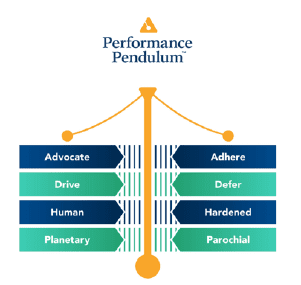
Exploring these eight leadership requirements, which are further defined by supporting competencies and observable behaviours, provides a tailored, practical approach to leader development in the nonprofit space. To mobilize the research-based framework, we are launching the Performance Pendulum Assessment and Accelerator™ leadership program, designed to focus on skill development and building capability across the leadership requirements outlined in the research-based Performance Pendulum™ framework. Beginning with a self-assessment, the Performance Pendulum Assessment and Accelerator™ delivers:
- Practical insights
- Actionable tools
- Peer group discussions
- Accelerated learning
Following completion of the program, participants have the option to participate in the accompanying 360 Assessment tool to measure and track progress with the guidance of an Accredited Coach in support of ongoing development and sustainability.
Ideal for high-potential leaders, current and emerging CEOs / EDs, enrolment is now open for the Spring session starting May 5 – June 23, and for the Fall, which runs from September 22 – November 10. The eight-week program is delivered fully online, one evening per week for 2 hours, and is facilitated by the Lake team, who hold deep knowledge of the research, leadership development design and delivery, and of the nonprofit sector. Each cohort will include a maximum of only 12 participants to optimize opportunities for meaningful group discussion and invaluable peer-to-peer support.
Email info@performancependulum.com for program details or to reserve your place in either the Spring or Fall session. You deserve it.
To learn more about our research, and to explore the Performance Pendulum™ leadership framework in more detail, you are invited to download the paper, The Neglected Sector: Leadership Development in Social-Profit Organizations, which can be found at Performance Pendulum™.
Rashmi Biswas is a leadership strategist, workplace learning expert, and skilled facilitator with a career spanning Canada, the U.S., and the U.K. With a Master’s degree in Human Resource Management, a Postgraduate Certificate in Adult Education, Facilitation and Training, Rashmi bridges theory and practice sharing over two decades of cross-sector insights with Clients in her role with Lake and Associates. Rashmi works with senior leaders across public, and private sector organizations, in non-profit, complex, mission-driven environments, and has provided consulting services across Canada, in South America, Asia, and the Middle East. Rashmi is a program facilitator with OISE at the University of Toronto, and currently serves as Vice-Chair of the Board of Governors for Niagara College.
The views expressed in this article are the author’s alone and do not necessarily represent those of CharityVillage.com or any other individual or entity with whom the authors or website may be affiliated. CharityVillage.com is not liable for any content that may be considered offensive, inappropriate, defamatory, or inaccurate or in breach of third-party rights of privacy, copyright, or trademark.
