
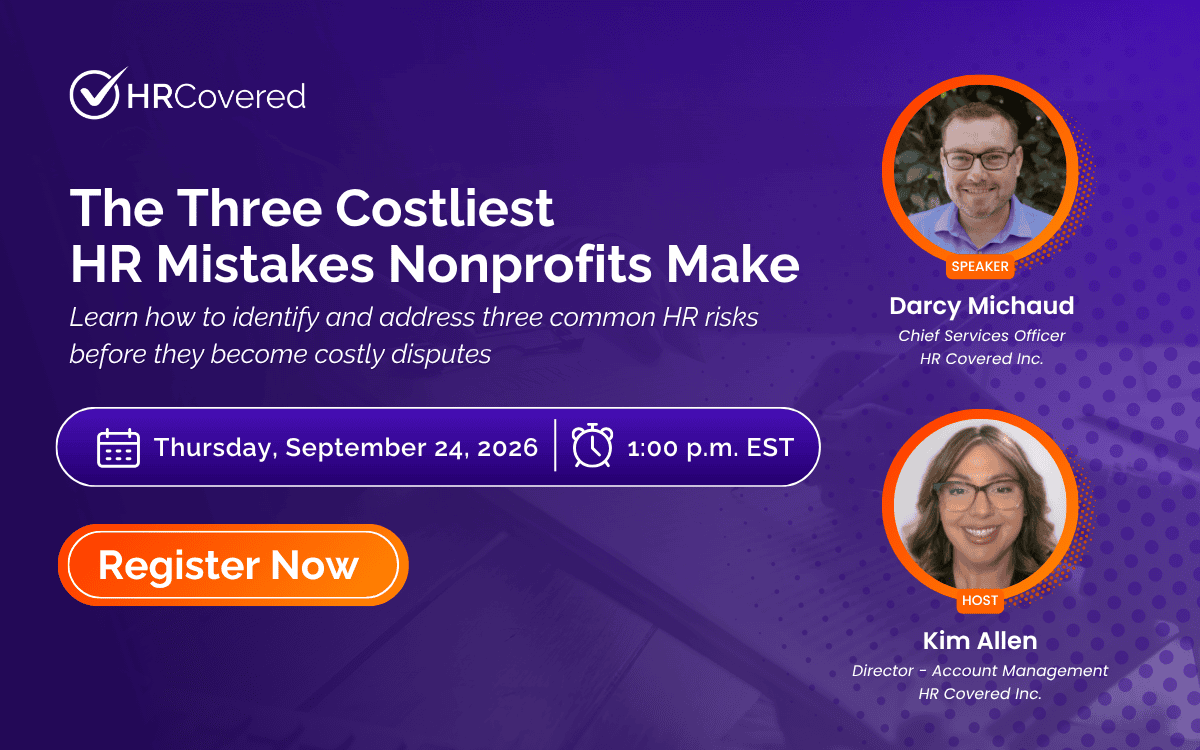

Interested in learning more? We have partnered with HR Covered Inc. to host a free webinar. Register now!
Running a nonprofit means balancing limited budgets, growing responsibilities, and a commitment to the communities you serve. HR may not be your primary focus, but when people’s issues are not addressed early, small oversights can quickly become expensive problems.
Most HR issues don’t become costly because someone ignored them. They become costly because small gaps go unnoticed until a difficult situation brings them to light. An employment agreement that hasn’t been updated in years. A workplace complaint handled informally instead of through a documented process. A termination where performance concerns were discussed but never recorded.
Across the nonprofit sector, the same HR issues tend to surface again and again. These are the three that deserve every nonprofit leader’s attention.
At HR Covered, we’ve worked with more than 2,500 Canadian organizations, including hundreds of nonprofits. While every organization is different, these three issues consistently create some of the greatest legal and financial exposure we see. The good news is that each one is preventable.
They’re also the focus of our upcoming webinar, The Three Costliest HR Mistakes Nonprofits Make, where Darcy Michaud, Chief Services Officer at HR Covered, will share practical guidance, real nonprofit examples, and straightforward steps leaders can take to reduce HR risk before problems arise. Whether you’re reviewing your HR practices or responding to a current challenge, you’ll leave with practical steps you can apply right away.
Based on our experience supporting nonprofit organizations across Canada, these are the three HR areas we recommend reviewing first.
1. Employment agreements that haven’t kept up
Having a signed employment agreement isn’t enough if it no longer reflects current legal requirements or the employee’s role.
Employment legislation continues to evolve, and court decisions regularly reshape how termination clauses are interpreted. Agreements that were appropriate several years ago may no longer provide the protection an employer expects today.
This is particularly common when employees are promoted or their responsibilities change. The organization updates the role but never updates the agreement.
Another common issue is relying on generic templates that weren’t written for the province where employees actually work. Since employment standards differ across Canada, agreements should always reflect the applicable provincial legislation.
Reviewing employment agreements regularly is one of the simplest ways to reduce future risk. As a practical rule, revisit them whenever someone is promoted, their compensation changes, or there has been a significant change to employment legislation.
2. Workplace complaints that stay informal
Nonprofits often build strong workplace cultures based on trust and close working relationships. While that’s a strength, it can also make difficult conversations harder.
When concerns involving harassment, bullying, or workplace conflict arise, leaders sometimes try to resolve the issue informally before following a documented process. Although the intention is usually to preserve relationships, informal conversations alone rarely provide the protection employees or organizations need.
Employees should know concerns will be addressed fairly, confidentially, and consistently. A documented process demonstrates that complaints are taken seriously while helping organizations meet their legal obligations.
It’s also important to make sure your managers know how to respond when a concern is raised. Even well-intentioned comments like “I’m sure it was just a misunderstanding” can quietly signal to an employee that their concern isn’t being taken seriously.
The process matters just as much as the outcome.
3. Terminations that trigger costly disputes
Many termination disputes begin long before employment actually ends.
Performance expectations may never have been documented. Coaching conversations happened verbally but were never recorded. Similar situations were handled differently from one employee to another. When these issues combine with an outdated employment agreement, what should have been a straightforward termination can quickly become a much larger dispute.
Organizations that manage terminations successfully usually have one thing in common: consistency.
Clear expectations, consistent documentation, and a fair process won’t prevent every difficult termination. They will put your organization in a much stronger position if that decision is ever challenged.
A quick HR check
Before your next hire, workplace complaint, or termination, consider these questions:
- Have your employment agreements been reviewed within the last two years?
- Do managers understand how workplace complaints should be handled?
- Are performance conversations documented consistently?
- Do your policies reflect current employment legislation?
If you answered “not sure” to more than one question, don’t worry. Many nonprofits are in the same position. The important thing is identifying those gaps before they become disputes. During the webinar, we’ll walk through each of these areas, share real nonprofit examples, and outline practical steps you can take immediately to strengthen your HR practices.
Join us on September 24
Darcy Michaud, Chief Services Officer at HR Covered, will be joined by Kim Allen, Director of Account Management, for a practical session created specifically for Canadian nonprofit leaders who want to strengthen HR compliance while reducing legal and financial risk.
Who should attend? Executive directors, CEOs, board members, operations and finance leads, office managers, and anyone responsible for HR within a nonprofit, whether or not it is officially part of their role.
What you will walk away with:
- How to identify employment agreements that need a second look
- What a compliant workplace complaint process looks like in practice
- Practical ways to reduce termination-related disputes before they happen
- The HR mistakes nonprofits make most often, and how to avoid them
- Answers to your specific questions during a live Q&A
Thursday, September 24 | 1:00 p.m. EST
About the Author
 Darcy Michaud, CHRL, MA is the Chief Services Officer at HR Covered Inc. and one of Canada’s most respected HR compliance experts. With nearly 30 years of experience, Darcy is known for simplifying complex employment law and HR compliance issues for businesses and not-for-profits across Canada.
He holds a Master’s degree from the University of Western Ontario and the Certified Human Resources Leader (CHRL) designation. Before joining HR Covered, Darcy spent a decade as Director of Human Resources for a large Canadian municipal government and later served as a senior consultant with Canada’s largest on-call HR consulting firm. HR Covered provides practical, Canada-wide HR compliance support, on-call advice, and ready-to-use HR tools for small and mid-sized organizations. Today, Darcy leads a national team supporting more than 1,500 organizations, helping them stay compliant, confident, and prepared for what’s ahead.
The views expressed in this article are the author’s alone and do not necessarily represent those of CharityVillage.com or any other individual or entity with whom the authors or website may be affiliated. CharityVillage.com is not liable for any content that may be considered offensive, inappropriate, defamatory, or inaccurate or in breach of third-party rights of privacy, copyright, or trademark.
